Friday, January 10, 2014

Mingun

We ate breakfast at the hotel, but could have skipped it. Our guide met us at 8:30 a.m. and walked us around the corner to a local noodle restaurant. The place was packed with people grabbing breakfast on the way to work or school, but we were the only tourists present, and drew some stares. Mary and I split a bowl of noodles with pork and a side bowl of soup and a cup of green tea. They were excellent, and the price was equivalent to about 80 cents U.S.

The coach met us in front of the noodle spot and took us to the river landing for a boat ride to the village of Mingun, which is up river and across from Mandalay. There are no bridges here, so the only way to get there is by boat. The ride was very pleasant in the morning sun, even with the boat's crew trying to sell us souvenirs. At Mingun we saw the ruins of what would have been the world's largest pagoda. It's still an impressively large structure, however, construction was abandoned when it was less than half finished, and earthquakes and weather have brought it to ruin. The entrance is guarded by two gigantic lions who have both lost their heads.

Mingun is something of an artist's community, and we bought a few paintings at one shop, and some small ornaments at another, on our way see one of the world's largest bells -- a 90 ton monster used in religious observances. We walked the streets of the village a bit, fending off overly friendly peddlers, and observed a family distributing quilts to elderly residents of one of Myanmar's few rest homes. It is considered a family obligation to care for the elderly, but if one grows old and happens to have not living relatives, care facilities exist. The conditions here did not make us envious.

On the boat ride back we stopped mid-river because a school of fresh water porpoises was breaching right in front of us. We were told that its rare to see one, but we saw dozens. Unfortunately, they surface and dive again much too quickly to photograph. The boat ride back across the river in the midday sun was even more glorious than the morning crossing had been.

Our lunch was at a Chinese roast duck restaurant. We ate everything except duck, and it was all excellent. We had only and hour or so of rest at the hotel after the meal before we were off again, this time to the Royal Palace of Myanmar, which is just across from our hotel. However, because it is surrounded with a wide moat, we had to drive some distance to one of the few gates to gain admission. What used to be the Mandalay equivalent to Beijing's "Forbidden City" is now the property of the military government of Myanmar, and remains an active military base (though the primary function is housing for military retirees and their families. Nevertheless, we had to gain "clearance" with the MPs to enter. The palace itself is well-preserved and has been used as a set in a number of movies. It is actually a compound of structures rather than a single palace -- again, similar to the "Forbidden City" in Beijing. We climbed a watch tower, which was clearly the inspiration for the design of the modern observation tower in Bagan, for a nice arial view of the whole place.

We next made a quick visit to a wood carving shop. They did great work, producing art much like that of the monastery we saw yesterday, but the working conditions seemed brutal. Men did the carving, but women were employed in the back of the shop doing very fine embroidery stitching -- also in conditions of which OSHA in the U.S. would not approve.

On next to a silks weaving factory, and of course, adjacent shop. The noise of the looms and the intricate work causing eye strain for the young women also did not cause us to envy the working conditions.

Finally, we spent the late afternoon until sunset at the U Bein bridge -- a long, teak wood foot bridge over a shallow lake that is nearly 200 years old (and in some places, showing its age). Although crowded with hundreds of tourist and locals alike, there are no railings. Like the factories, health and safety is your own concern. The bridge made great people-watching, as well as sunset watching, and was clearly seen by the locals as a romantic spot. We even had to stay out of the way of one couple getting their wedding photos taken in full white gown and tux. It was also a good place to celebrate for one of our group members having a birthday today.


Thursday, January 9, 2014

Mandalay

We were up early for breakfast and a trip to the airport for a brief, half-hour flight to Mandalay. From the airport we went immediately to Mahamuni pagoda where we saw a large sitting buddha onto which the faithful were placing layer upon layer of wafer thin gold leaf -- so much that the statue has lost all proportion. The men got to go right up to the buddha to see this up close, but the women were not allowed and had to watch from about 20 feet back. If this vantage point was not close enough, they could go around to the back of the sanctuary and kneel on a carpet before a flat screen TV that was showing a closed circuit feed from a close-up camera!

We were also fortunate to observe part of a "novitiation" ceremony in which a boy of about 7 years of age was being inducted into the monastery as a monk. However, he is only required to remain a monk for 7 to 10 days before returning home to his family. The whole extended family was there for this right of passage, all decked out in the finest attire, and all wearing heavy makeup -- including the boys. Buddhists return to the monastery periodically through life for brief periods of living the monastic life. We are unclear how seriously some take this, however. We frequently saw teenage monks with Western clothes under their robes, carrying fancy smart phones, hanging out as tourists, or even holding hands with their girlfriends. It's clear that monasticism does not always involve the same sort of sacrifices we usually think of in Christianity.

We next drove to a place where all that gold leaf in produced. Tiny bits of gold are placed between sheets of a special, very thin paper made from bamboo pulp. Then dozens of layers of these papers are stacked up in a packet bound in leather with steel plates top and bottom. The packet is placed on a sort of anvil, and guys with big sledge hammers beat it repeatedly for hours. The sharp ring of the hammer strikes echoes throughout the place, so much so that the hammerers generally go completely deaf after 20 or so years of working there. We were told that machine hammers had been tried, but that the same thinness of gold leaf could not be achieved. We suspected, however, that with common labor at just over $3/day, deaf humans are cheaper than the machines. In another room, where the ringing of the hammers is only marginally quieter, women separate the sheets, count them out, and package them for sale in small plastic bags.

We next visited an 18th century monastery constructed entirely of intricately carved teak wood. The carvings served the same function as stained glass in Medieval cathedrals, relating sacred stories to illiterate people. The monastery consisted only of two large rooms, one for worship and meditation and another, with book shelves, to serve as a classroom, library, and at night, as the sleeping area where matts were unrolled on the floor. Cooking and other functions of life would take place outside, or underneath the building, which was raised about five feet off the ground on massive teak stilts (Mandalay frequently suffered from flooding in the rainy season). The monastery is no longer used as a residence, though monks from a newer facility still come there occasionally to study or pray. The reason they've moved out, we were told, was fire danger. But the only fire protection for this priceless relic were some red buckets of sand and a garden hose! One match could easily take it out.

We visited yet another pagoda, the Kuthodaw, which is known as "the world's largest book." Surrounding the main pagoda are 729 tiny buildings about 5 feet square, each containing a stone tablet engraved with a page of Buddhist sacred text. So the entire pagoda is a "book" of 729 pages.

Late in the afternoon we left our comfortable coach behind and boarded one of the local "busses" consisting of a pickup truck with a canvas cover over the bed, and two long boards for benches. The vehicle took us on a wild and winding trip up the steep Mandalay Hill. At the top is another pagoda, which meant going the rest of the way in bare feet (as we have had to go in all of the pagodas). Fortunately there were escalators to take us up the final 200 feet (but we've never ridden an escalator barefoot before)! At the top there was a fantastic view, and of course, many buddha statues and sanctuaries. We opted not to stay until sunset, but it was nearly dark when we returned to the hotel.

Mary and I took a long walk in the evening. Despite being on our feet all day, we get little actual exercise to burn off all of the food we are eating. We skipped dinner for a light snack, and it felt good to walk at a brisk pace for a change. Unfortunately, uneven sidewalks and lack of street lighting sent us back to the hotel too quickly for an early night.

Wednesday, January 8, 2014

Nanmyint

The hotel breakfast was very adequate. We saw that one of the couples staying at the hotel were the bride and groom from the big wedding we had witnessed in the Yangon hotel. Apparently one set of parents/in-laws were accompanying them on the honeymoon! Near as we could tell, however, the parents were in a separate room.

After breakfast, Mary and I took another brief walk around the neighborhood, then boarded the bus to a rendezvous with horse-drawn carriages driven by locals who drove us through the area of a number of the pagodas. We stopped briefly at the "ghost pagoda," one of the largest, and named for the "cries" heard at night when the wind blows through it. The legend is that the builder would come to inspect the work, and if he found any substandard workmanship, the workman responsible would be executed on the spot. We're not sure how many died during the construction, but we can't imagine that the punishment would be carried out too many times before the quality of the workmanship rose to a rather high level!

After leaving our carriages behind, the bus took us to a sandalwood museum. This could have been skipped, though it was interesting to see that the use of ground sandalwood as a cosmetic goes back more than 2000 years, and that petrified sandalwood, which is also plentiful in this part of the world, is made into jewelry as sort of a cheap substitute for jade. I also discovered that the sandalwood mixture works pretty well on insect bites, as I had picked up a few bites on my right foot during our time out in the countryside.

As the bus was heading back to the hotel, we happened to pass the lacquer-ware factory from yesterday, and a great cry went out from the group to stop once again. Several purchases were made, including one by Mary and I. Then it was on to the hotel for a period of relaxation and lunch on our own. Mary and I ate only a few pieces of fruit, as we've been feeling quite overfed. Sitting by the pool was extremely pleasant, as the weather in nearly perfect -- probably around 80 with sun and very little humidity. It's hard to believe people back in Iowa are battling record low temperatures. Stories of the cold there have even made the international news stations!

Mid-afternoon our group left again to see the archaeological museum of Bagan, which focused primarily on the Bagan period of Myanmar's history, 11th-13th centuries C.E., during which most of the pagodas in the area were built. However, there were also some artifacts from the Pyu Period, beginning in the 1st century C.E., during which Myanmar's distinctive culture began to emerge. We found it quite an interesting display, and the locals are clearly very proud of this very new and very ornate building.

We then drove quite a ways to Nanmyint, a very fancy resort hotel with golf course where there is a new, 11-story tall observation tower. We rode the lift to the 9th floor restaurant where we were served a soft drink and could walk around, looking out the windows. We then climbed the stairs to the open-air observation deck to take photos and marvel at the view. On the way down, five of us entered the elevator and started down when there was a sudden power failure. There was no emergency lighting, so we were stuck in the lift in total darkness. Cell phones quickly produced some light, and after about a minute, the doors popped open a bit and we could push them the rest of the way. We were on an unfinished floor, with nothing but bare concrete and steel beams. But we got out and found the stairway, finally getting down to a waiting area on a lower floor where we sat to catch our breath. Then we continued down on the exterior stairway, winding around the tower, to the third floor. By then the power had been restored, and we got back on the elevator to go the rest of the way. It was truly our adventure for the day!

We continued farther out into the countryside and visited a rural village that has not yet been ruined by tourists. The people were somewhat curious about us, but extremely friendly and welcoming. We were invited into the yards of several people who were anxious to show off their bamboo homes, children, livestock, cigars, etc. It was an interesting learning experience, especially watching people carrying water to their homes in preparation for the evening meal. We don't realize how spoiled we are in the First World.

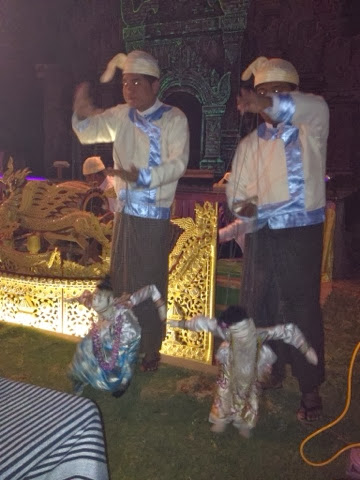
After a bit over an hour at the rural village, we drove back into the city, very near the hotel, where we ate at an outdoor restaurant with live entertainment consisting of musicians, dancers, and puppeteers. It was quite interesting, but became somewhat repetitive and the air began to get chilly for some (possibly way down into the 60s)! One interesting bit: After the marionette show, the puppets come down into the crowd (with their operators right behind, of course) to beg for tips. They can do what would be unseemly for the humans.

Tuesday, January 7, 2014

Bagan

Though we went to bed early neither of us slept particularly well. We were up by 3:45 a.m. to get on the coach to the airport and catch a very early flight on a small turbo-prop from Yangon to Bagan. Though it was only about an hour flight, we were served a soft drink, offered a newspaper, and served a light breakfast that was superior to the box breakfast we had been given at the hotel (it was awful!). Upon landing, we noted that the airport workers (including the women sweeping the tarmac with brooms!) and all of the cabbies and coach drivers outside were wearing parkas and stocking caps. We were in short sleeves, as it was in the upper 60s!

The land around Bagan appears to be scrub grass savannah with very few crops being grown and trees only in the fence rows, or if in a wooded area, spread about sparsely. When we got closer, it was clear that it is very poor soil, a fine sand, almost dust or powder. We can't imagine how bad the dirt roads here must be in the rainy season! We were in a "city" of 70,000 but had not yet seen any homes or dwellings, only the countless monuments, shrines, temples and pagodas dating back 700-1,000 years. It is clearly an area less modern, less prosperous and less developed than Yangon.

Our first stop was a pagoda described to us only as "the second highest." The highest one was pointed out to us several times, but it is no longer open for climbing. This was a brick terraced pyramid roughly 60 feet tall at the top terrace, with an elongated dome set on top of it. Several of us climbed to the top terrace, while several others stopped at about the second. The steps were extremely steep with wide and irregular risers and narrow treads. I could see why some would be spooked by the climb, especially since we had to leave our shoes at the bottom and go up with bare feet. The view, however, was spectacular, especially in early morning light. One could see for several miles, and pagodas rose at some point in virtually every direction.

The souvenir hawkers at the bottom -- and everywhere else in town -- were much more aggressive. Many are children, who should most properly be in school. Though the country has not been open to tourists long, they have learned very quickly. In a country where the average laborer earns 3000 Baht (just slightly more than $3) per day, it isn't surprising that trading on tourists would be attractive.

We drove on to a lacquer-ware factory where the process was explained by a personable little man who seemed to very much enjoy giving his talk. Myanmar lacquer-ware is much different from that we've seen in China. The Chinese process involves decorating a copper core with a thick glaze and firing it. This process involves bamboo or horse-hair forms covered with many coats of tree-resin lacquer that is hand polished. Our guide advised us not to buy in the shop at the factory, but that she would take us to another shop that would be cheaper. We found the second shop to be more expensive and to have less interesting designs. We wished we had purchased something at the first place.

We had lunch at a very pleasant outdoor restaurant along the bank of the Ayr Aye Waddy (often called the Irrawaddy River by the colonials, but since Waddy is the Burmese word for river, it is redundant, as well as mispronounced). The food was carried to the table on a kind of cart hung from pole that was carried over the shoulders of two guys, with a third guy walking ahead and sounding a gong. Quite a spectacle! And the food was excellent, as well.

After lunch we checked in at our hotel. We were surprised to discover how nice it was, and more surprised to find wi-fi (though the connection was so slow that the devices of our group quickly overwhelmed it and made use of the internet impossible). Our guide had warned us that there would be no internet in this remote spot, but things are developing here so quickly that it's hard to keep up, even when one is here every two or three weeks. We were planning to rent bicycles and ride around the town, but with the early morning and the lingering effects of jet lag, Mary was feeling particular bad, and my energy level was low, so we rested at the hotel until our evening activity. We did manage to rally for a walk around the neighborhood, observing dirt streets that we can't imagine would be passable in the rainy season, very rough thatched homes alongside fairly nice stucco houses, and stray dogs everywhere. We saw a huge number of students heading home after school at 3 p.m. The uniforms are the same for boys and girls: white shirt, and plain dark green, ankle-length sarong wrap-around skirt for both.

Our evening consisted of a boat ride across the Ayr Aye Waddy to watch the sunset. It was pleasant, though not spectacular. Our guide brought beer and snacks, but no bottle opener, so we had to improvise (recalling our college days, before twist-off caps). I didn't spill too much, and broke no bottle necks. There were many boats on the river doing what we were doing -- all tourists, no locals. The other boats, like ours, were barely seaworthy, with rough-sounding outboards that were reluctant to start and tillers made from used pipes. The children selling souvenirs were back with us as soon as the boat touch the bank on return.

We went to dinner at a gorgeous, very modern, outdoor restaurant with live music from two traditional musicians. The young man playing the traditional Burmese harp and bamboo xylophone was quite accomplished. The somewhat older woman who "sang" was awful. None of the others in our group could hear through the pentatonic tune that she was off key, but our guide (who knew from memory every song the woman sang, and who would have done a much better job) agreed that she was not very good. Our guide also mentioned and demonstrated slightly, while still seated at the table, that there were dances that accompanied these traditional tunes. The woman on stage was merely sitting. Just from watching our guide's hand gestures, it was clear that she had had dance training. If the guide thing doesn't work out for her she can still do OK as a stage entertainer.

We returned to the hotel and by 8:30 p.m. could no longer stay awake, but we were awake again very early. I resorted to a sleeping pill, but only managed a few more hours of sleep.

Monday, January 6, 2014

Shwedagon Pagoda

We began the day with a visit to the amazing Shwedagon Pagoda, which is actually a sprawling complex of pagodas. The architecture is pretty over the top. The guide told us there were 60 tons of gold leaf here, and that is believable given the number of gilded spires and statues. We did wonder how the flashing colored lights behind some of the buddhas could be an aid to meditation. Clearly there were people here engaged in pious worship, but for many others it was equally clear that the visit to the pagoda was more of a family outing. We saw large family groups picnicking in various spots, and enjoying the antics of playing children.

We passed by another beautiful pagoda on the way to a local monastery, Kalaywa Tawya. The We began the day with a visit to the amazing Shwedagon Pagoda, which is actually a sprawling complex of pagodas. The architecture is pretty over the top. The guide told us there were 60 tons of gold leaf here, and that is believable given the number of gilded spires and statues. We did wonder how the flashing colored lights behind some of the buddhas could be an aid to meditation. Clearly there were people here engaged in pious worship, but for many others it was equally clear that the visit to the pagoda was more of a family outing. We saw large family groups picnicking in various spots, and enjoying the antics of playing children.

We passed by another beautiful pagoda on the way to a local monastery, Kalaywa Tawya. The monastery housed more than 1400 monks and nuns (in separate compounds), almost all of them children. We learned that almost all of them were orphans -- many who lost parents to the military regime. At the monastery they receive food and shelter, a couple of robes to wear, medical care, and (perhaps most important) education. Most leave the monastery when they reach adulthood, so the education is vital when they enter the real world. They also spend several hours a day begging for food on the streets, so this may also be a useful life skill.

Both of us are having trouble with jet lag -- Mary is struggling even more than I -- so we spent the afternoon reading and relaxing. In the afternoon the group visited the famous Strand Hotel, bastion of British imperial culture. We toured the art gallery there, were treated to a brief lesson on the bamboo marimba from the musician in the lobby, and visited the bar, which might have been imported straight from an English pub. We continued on foot through a small market and onto the docks of the waterfront to watch commuters find their way onto ferries that could take them to their homes on the opposite side of the river, and to watch the sunset over the water. We then walked through Yangon's "China Town," which is a busy street market that spills out into the streets, making for some interesting encounters with traffic. In the evening our group enjoyed an excellent meal in the house that once belonged to General Ang Song, liberator of his country and father of Ang Song Suu Kyi.
monastery housed more than 1400 monks and nuns (in separate compounds), almost all of them children. We learned that almost all of them were orphans -- many who lost parents to the military regime. At the monastery they receive food and shelter, a couple of robes to wear, medical care, and (perhaps most important) education. Most leave the monastery when they reach adulthood, so the education is vital when they enter the real world. They also spend several hours a day begging for food on the streets, so this may also be a useful life skill.

Both of us are having trouble with jet lag -- Mary is struggling even more than I -- so we spent the afternoon reading and relaxing. In the afternoon the group visited the famous Strand Hotel, bastion of British imperial culture. We toured the art gallery there, were treated to a brief lesson on the bamboo marimba from the musician in the lobby, and visited the bar, which might have been imported straight from an English pub. We continued on foot through a small market and onto the docks of the waterfront to watch commuters find their way onto ferries that could take them to their homes on the opposite side of the river, and to watch the sunset over the water. We then walked through Yangon's "China Town," which is a busy street market that spills out into the streets, making for some interesting encounters with traffic. In the evening our group enjoyed an excellent meal in the house that once belonged to General Ang Song, liberator of his country and father of Ang Song Suu Kyi.

Sunday, January 5, 2014

Yangon

We lost a day crossing the International Date Line, so there was no Saturday for us this week. We went to breakfast and met a number of people, but few who were on our tour. When it was time to load the bus for departure back to the airport, there were five others in the group: three siblings (two brothers and a sister) from Seattle, along with the spouse of the eldest brother and the partner of the sister. They are nice folks, but of course, since they all know one another, we are a bit the odd couple out. On the flight to Yangon (the city formerly known as Rangoon), the small Thai airline provided a second breakfast -- not something one would get on a flight of slightly more than one hour in the U.S.

We were met at the airport by our guide, "SuSu," a very energetic, pretty 26-year-old Yangon native with a degree in English and fluency in Spanish and Japanese, as well. As soon as she had us collected, she informed us that we would not be going immediately to the hotel for a day of rest to get over jet lag, as in the guidebook, but would have our luggage taken to the hotel ahead of us as we set out for an immediate day of sightseeing. This was necessary because most of the places we wished to see in Yangon are closed on Mondays.

Our first stop was the famous reclining Buddha, at a length of 70 meters, the fifth largest Buddha in the world. He's not all that old, dating back to 1902, but is quite impressive, especially the symbols carved on the bottoms of his feet. We had to get used to walking barefoot in the pagoda, which was easy inside, except for places that had just been hosed down, where the wet marble was extremely slippery. But walking barefoot across the parking lot was more challenging. We were expecting to be able to walk up to the entrance and remove our shoes in a particular place, as with the mosques in Egypt or Turkey, but no such facility here.

Next we visited the city plaza in the middle of downtown Yangon, where we saw the independence monument, city hall, and some other colonial architecture. There were several things we noted on the streets while driving: Traffic drives on the right side in Myanmar, but many, if not most, vehicles have the steering wheel on the right side, as if for left side traffic. Our guide offered several explanations. First, the British used left side traffic through the colonial period, and this had continued after independence (as in Thailand) until fairly recently. In about 2006 or '07, the military government (intent to do away with all things British) commanded a certain date on which traffic would reverse to right side driving (one can imagine the chaos -- however, our guide reminded us that at that time there were very few vehicles on the roads, and virtually no private cars. Second, since Myanmar's opening and the surge in the economy, most people still can't afford to buy a new car, so most cars sold come into the country used from Japan or Thailand, where people drive on the left side. Another thing we noticed were pick up trucks outfitted as "busses," something like those in Africa. These were often so crowded that there were many riders outside, hanging on for dear life!

We then went on to the Scott Market, which was much like other markets around the world, except much more tilted toward selling jewelry to tourists. Along the way, our guide showed us how Myanmar women, and many men, treat their faces with a stone-ground mixture of sandalwood and water that keeps the skin from weathering in the sun. We went on to lunch at a place very near to the home where "Our Lady," Ang Song Suu Kyi, was kept under house arrest by the government for many years. After a good meal (that left us feeling quite full after two breakfasts) we checked into the hotel. It was very nice, but has a great deal of renovation taking place and very flaky wi-fi.

After a bit of rest, we gathered again to visit the National Museum, which was more interesting than we had anticipated. We learned of the great animosity toward the British here for the theft of a number of national treasures. After a couple hours of museum time, we returned to the hotel to prepare for our welcome dinner at a nearby restaurant. It was good, but we were all still quite full from earlier meals.

It's wedding season in Myanmar. When we returned to the hotel we found two very large and extravagant wedding receptions in progress. One was in a ballroom, the other was a sit-down for 300+ people around the pool with a live band, full video crew, and lots of fancy outfits. The bride was a graduate of Yale with a Ph.D. in neuroscience from Penn State. The groom an MD working on a Ph.D. in neurology, also at Penn State. Given the political climate in recent years, we had to assume that both families had military connections, else they would not have been able to study outside the country. There was obviously money in the families, as well.

Again with the help of sleep medication, we managed to get a good night's sleep, even if it ended early.

Friday, January 3, 2014

Ancient Kingdoms

Katherine drove us to the airport in frigid cold at 4:30 a.m. for our 6:25 a.m. flight to Chicago. The flight was initially delayed for crew time between flights, then we boarded and taxied out, but the pilot came on speaker to say we were taxi-ing back to the ramp because of a brake indicator light. The anti-lock brakes had frozen on the plane and needed to be heated for 20 minutes prior to take off. We got into Chicago almost an hour late, but we still had plenty of time to catch our flight to Tokyo. The gate was about as far away from our arrival gate as any two gates can be at O'Hare, but the walk was good for us, given that we had a 13 hour flight ahead. 

At the gate, we were approached by a woman who noticed the OAT logos on our jackets, and that led to our being introduced to two couples from Winnipeg, Canada, who were on the way to the same tour, except they were not taking the pre-trip to Burma. They would be in a group a week ahead of us. We were sorry about that, because they were very nice people and would have been good traveling companions.

ANA was an excellent airline to Tokyo, the service was Japanese and the food was pretty good. We read, watched a couple of movies each, but didn't sleep much, if at all. At Narita we found outlets to recharge our pads (though it wouldn't have been absolutely necessary to do so) and chatted with the Canadians. We also tried to walk a bit, since we had been sitting long and had another 7 hour flight ahead. Once on the ANA flight to Bangkok we were determined to get some sleep. When the drink cart came around I asked for Scotch. Instead of handing me one of the little bottles, the stewardess dug out a pint jug and poored me a generous glass. I mixed it with water and used it to down a sleeping pill. I was out for three hours! Mary also managed a couple hours of sleep, so we weren't in bad shape when we arrived in Bangkok.

The airport at Bangkok is large, new, and quite nice. But it is so big that there are several exits from Customs spread far apart. Also, OAT was bringing in a number of different groups at the same time. This made it rather confusing to find our proper contact. Since all of the groups would be going to the same hotel, it seemed rather odd to us that they were so intent on separating everyone at the airport. In the end, we were the only two passengers in a van to the hotel. The hotel room was very large and nice enough, though a bit old and threadbare. We had no trouble getting to sleep, but were were awake well before the alarm or wake up call.