Thursday, June 9, 2016

Bath Day

We felt quite proud of ourselves for navigating swiftly to Deak Ter, a plaza that is one of Pest's central transportation hubs. There we quickly identified the correct bus stop and jumped aboard one of Budapest's frequent and efficient buses (Malta should take lessons from these folks!) which took us across the river to Buda and up to the Citadella, or castle hill.
Hungary has not had a monarch since the end of World War I, and the Royal Palace was almost completely demolished as Nazi and Soviet forces sought the high ground in World War II. It was rebuilt as a museum piece during the Communist era, according to plans that bore little resemblence to the original design. As the Rick Steves book puts it, "it has no soul."

Nevertheless, the views from up here are spectacular, and there are some interesting sights around the exterior. We began by visiting the statue of the Turul bird, a mythical creature that supposedly led the Magyar tribes out of central Asia and directed them to settle in Hungry. (Apparently the bird occasionally took wrong turns, as some of these tribes wound up in Finland, instead.)

Since birds are popular here, we also saw several versions of a raven with a gold ring in its beak. This is the symbol for King Matyas (Matthias) I who ruled 1458-1490. Matthias is sort of the King David of Hungary. He held the Turks at bay, expanded his rule to empire proportions, and was known as "The Just" for his concern for the common people.

On the opposite side of the hill is an ornate, neo-Gothic church known as Matthias Church -- even though Matthias has never been canonized as a saint, nor was the present church around until long after he was gone. 

There has been a church here since the 11th century, but the series of buildings has been destroyed and rebuilt so many times that I think even the Hungarians have lost track. This one was built 2006-2013 after laying in ruins after WW II and through the Communist era. It looks the part, though. The interior looks entirely Medieval.

From the Citadella we returned by bus to the bottom of the hill. We had planned to bus all the way back to Pest, but our failure to discern the difference between Route 16 and Route 16A left us at a different transport hub on the Buda side. No worries, we simply got on the Metro and flew underground to our next stop, TerrorHaza.

The House of Terror didn't intrigue me when I first heard the name -- it sounds too much like a Halloween attraction. But this house, built in 1880 on a beautiful, tree-lined boulevard in a neighborhood of 19th century affluent residences, was a different sort of terror. In 1937 it became the "House of Loyalty" for the "Arrow Cross Party," Hungary's version of the National Socialists.

When the Nazis took Hungary in 1944, brown-shirted members of Arrow Cross were distinguishable from Nazis only by the insignia on their arm bands. The "Loyalty House" at 60 Andrassy Boulevard became the Gestapo headquarters. With Soviet occupation in 1945, the address remained the same, only the names of the torturers changed.

The museum unfolds this history in Hungarian and in English, culminating in the basement prison cells and execution chambers. There is even one large room about the role of the churches -- not only the marjority Catholic Church, but also the Lutheran and Reformed churches -- and how these were undermined by the regimes.

From TerrorHaza, it was not a long walk up Andrassy Boulevard to Hero's Square, a large city park, and the Szechenyi Baths. One of the things the Turks left behind was the concept of the Turkish bath (which, to be fair, the Turks inherited from the Romans). The Hungarians take their baths seriously, and this 100+ year old facility is popular with the locals, as well as the tourists.

We paid a little bit extra to have a "cabin" in which to change and hang our clothes. For local men, the tiny, classic Speedo racing suit is the standard uniform. My current swimwear tends to have more fabric. Women's suits range across fashion trends, generally with more fabric for older women than for younger. There are pools of various temperatures, with the largest outdoor pool at 37C (that is, 98.6 degrees fahrenheit).

After lounging in the various pools for nearly a couple of hours, we showered and changed, only to be blessed by a cold afternoon rain shower on the way back to the Metro. It had been sunny all day, so we hadn't thought to bring our umbrellas. Nevertheless, we made it back to the hotel. We enjoyed yet another excellent Hungarian meal in a neighborhood restaurant.

After dinner, we strolled briefly in the area that, prior to WW II, had been the Jewish Quarter. This area was the low rent district after the war, and after the Communist era became the location of "ruin pubs." These were funky little bars in the ruined and unrestored buildings that became popular with the young and the counter-culture crowd. Today, they are mostly about young tourists, expensive drinks, and "consumption girls" (as translated literally from the Hungarian).

We didn't stay long, as it wasn't our kind of atmosphere. But having at least seen a bit of it, we returned to the hotel where, relaxed from the baths, we made it an early night.

Wednesday, June 8, 2016

Danube Bend

For today we had pre-booked a day-trip out of Budapest to the "Danube Bend." This is an area northwest of Budapest, very near the border with Slovakia, where the river makes a fairly sharp "S" curve. The area was formerly the Hungarian capital and remains the center of Hungarian Catholocism.

We were picked up promptly at our hotel at 8:30 a.m. as promised. The taxi stopped at one other nearby hotel to pick up another couple (Australians) and brought all four of us to the meeting point where our tickets were checked and we were put on a very nice, large motor coach.

There were several Canadian couples on the bus, as well as a family from India. We didn't really meet many of the others, but the English language tours tend to attract many for whom English is a second language. There are tours in Spanish, French, German, and Russian, but not in Danish or Polish, for example. So people from those countries, and some Asians, find the English tour their best option.

Leaving Pest, we crossed to the Buda side and drove along the river for about 90 minutes to Esztergom, a village on the right bank of the river overlooking the Slovak town to Sturovo. A thousand years ago Esztergom was Hungary's capital city, and the Slovakian side of the river was also a part of it. The castle of Hungary's first king, Istavan, was built on this high hill, and a cathedral was built right next to it.

When the Turks finally succeeded at conquering Hungary (after nearly 200 years of trying) in 1526, the castle became a ruin and the cathedral a mosque. When the situation was reversed in 1699, the capital was moved to Budapest, but the archbishop remained at Esztergom. The current church was built in 1856, incorporating some parts of older churches dating back to pre-Ottoman times.

After touring the church, we drove over the bridge to Sturovo, setting foot in Slovakia for the first time, simply for a photo stop.

Returning to Hungary, we retraced our route back to Visegrad, and then up the mountaiin for a three-course lunch and a great view of the valley. The food was better than expected. The old guys supplying the live Hungarian music, we decided, must have been deaf. We can't remember hearing such awful music played by supposed "professionals." They couldn't keep a beat, couldn't stay together, and couldn't play in tune. It was painful. They should have taken the hint when they finished a piece and no one clapped, but they kept on with the torture through the meal.

Back on the bus, we continued backtracking toward Budapest to the village of Szentendre (St. Andrew), where the bus left us for the final time. We had a brief guided tour of this quaint, but extremely touristy "artists' village," then we were turned loose to spend money. We actually fulfilled that expectation, at least to a small degree.

Promptly at 5 p.m. the last boat sailed down the Danube from Szentendre to Budapest, and if we wanted to get back, we had to be on it. No one from our bus group appeared to be left behind. The trip was pleasant enough, but there wasn't a great deal to see other than kayaks and rowing shells.

I've heard that a waltz was written called, "The Blue Danube." Nice tune, but the Danube is no longer blue. Rather, it's more of a muddy brown. We were deposited at a dock just blocks from our hotel.

After a very fine meal we strolled back to the riverbank to see the city lights along the river, then called it a day.

Tuesday, June 7, 2016

Budapest

Our students are gone! All have flown home, save two who are traveling on their own in Europe, but no longer our responsibility. So we have flown the coup! Or at least flown from Malta on an evening flight to Budapest.

We arrived Monday evening around 9:30 p.m. so we didn't really see much in the dark on the way to our hotel. The hotel itself shows residual effects of the Soviet era (at least the carpet dates back that far), but it's clean, the price is very reasonable and the breakfast is pretty good.

In fact, prices for many things are quite low. It's a bit difficult to realize, since the Hungarian Florin runs about 300 to the Euro. So buying an excellent meal with a glass of wine for 3600 HUF sounds extravagant, it's really only $13.17 (or €11.60 in the currency we've grown used to).

Today we set out from the hotel about 8:30 a.m. The city was remarkably quiet and sleepy at that hour. The pedestrian mall, Vaci Utca, was remarkably empty. We sort of meandered our way toward Saint Istvan's Basilica, a late 19th century neo-Renaisance structure, which was likewise uncrowded.

The 18th and 19th century buidlings that make up the city's center are remarkably ornate. Even the most mundane apartment building has touches of baroque stonework if one simply looks up. Sculptured cupids or other figures guard doorways all over town.

Parks, plazas, and other green spaces are abundant, and we realized how long it has been since we walked on grass (Malta doesn't have much of that). Something else foreign to Malta is the rushing Danube River, dividing Buda from Pest (though they are linked with several grand bridges.

We visited Szabadsag Ter (AKA "Liberty Square") where we walked past the U.S. Embassy, saw a bronze statue of Ronald Reagan (why?), and saw a memorial to the Soviet troops who liberated Hungary from the Nazis (not all Hungarians are happy about that one, as the protest banners attest.)

We continued on to Kossuth Ter, which is just outside the grand Parliament House. Who knew that Kossuth County, Iowa was named for a Hungarian freedom fighter of the 1840s? We walked on and crossed the bridge to Margit Island, which was crawling with kids on field trips (from pre-school through high school) where we sat awhile and watch a fountain splash. We noted that the previous day's work of getting students sent off and flat tidied had left us with little energy.

After a bit of liquid refreshment at a sidewalk cafe, we went back to Parliament House for the 1 p.m. tour for which we had booked tickets. 

The opulent guilded chambers were testimony to Hungary's golden age during the Habsberg dynasty in the 19th century. Modern Hungary is a considerably smaller and less wealthy member of the European Union, yet cherishes its 1000 year history of nationhood and occasional empire.


After the Parliament tour we walked along the Danube, stopping briefly at the poignant memorial to. Jews killed by Nazi-sympathizers in 1944 (just bronze castings of shoes on the riverbank), and at the esquisite Gresham building, now restored as a five-star hotel. We also noted how the river cruise companies (Viking, Grand Circle, etc.) dock their boats and release hundreds and hundreds of American tourists a day in this city.

Finally, we visited the Great Market Hall, another 19th century marvel housing stalls where locals and tourists can buy fresh vegetables, spices, meats and sausages, Hungarian wines and handicrafts, and of course, tourist t-shirts. We stopped for a cheesy Hungarian pastry.

On the way back to the hotel along Vaci Utca we stopped for yet another liquid refreshment at another sidewalk cafe. This was a less pleasant experience, in the end, due to an arguement with a waiter who cheated us on the bill. That was immediately followed by another negative experience of getting lost.

But in the end we found our way, made note of some sites to which we will return later, and after a respite at the hotel, enjoyed an excellent (and very reasonably priced) traditional Hungarian meal. My phone's fitness app says we walked 10 miles today, and we're feeling it. We shall sleep well.

Friday, June 3, 2016

Harbor Cruise

The last day for Katherine and Matt's visit we started out by bus for Valletta. By now they had been through the Valletta Bus Terminal multiple times, but they had not yet been inside the city wall. Today we went straight in.
View of the Three Cities from Upper Barrakka Gardens
After pointing out the moat, new Parliament building, and the performance center, we took a peak inside Our Lady of Victories chapel (the oldest church in Valletta). We passed the Auberge de Castille and the Malta Stock Exchange, then entered Upper Barrakka Gardens.
Scaffolding still obscures the ceiling at St. Paul's Shipwreck, but at least the lights are on
This was actually our first visit to Upper Barrakka Gardens. This spot had been mentioned several times in class lectures, but somehow we had always missed it. We'd seen it from below only. It really is the best view of the Grand Harbor.
Enjoying a bit of shade at Lower Barrakka Gardens
We hastened down Republic Street to the Co-Cathedral. Mary and I had just visited recently, so we briefed our guests about the highlights (especially the Caravaggio paintings in the Oratory) and sent them in while we waited. The price of admission is a little steep for a return visit so soon.
A modern Armed Forces of Malta patrol boat contrasts with the 500 year old walls of Valletta
From the Co-Cathedral we went almost immediately to the Church of St. Paul's Shipwreck, one of our favorites. The renovations in this church appear to be nearing completion, and the lights were on for a change. This gave us a different view than we've had before.
Harbor cruising
It turned out that the schedule for tours of the Sacred Infirmary was not going to allow a visit there today, so we simply briefed them on the outside of the building and took in more harbor views. It was a short walk to the Lower Barrakka Gardens (a place we have visited a number of times before), and then walked back to St. George's Square, but there was no changing of the guard at the Presidential Palace as setup was in progress for some sort of entertainment event in the Square.
Migrant rescue vessel
To compensate ourselves for the loss of the Infirmary visit and guard changing, we stopped at Amorino for gelato on waffles. Then we hoofed down hill to the ferry for the return to Sliema.
The Knights of Malta withstood the Siege of 1565 at Fort St. Angelo
Part of the "deal" for our cruise to Gozo and Comino two days ago was an added "free" harbor cruise. Mary and I had always assumed these would be pretty lame, but since we'd already paid for it, we decided to take the ride. It was surprisingly informative, and interesting to see familiar places from a different perspective.
A worker high on the mast of a yacht in the harbor
After the harbor cruise, we returned to the flat so that Katherine and Matt could finish packing for their trip to the airport. They took their gear with them and we enjoyed "happy hour" at a pizza place by the bay, near the bus stop. We then sent them off to the airport full of pizza and German beer.

Thursday, June 2, 2016

West Coast

We took Katherine & Matt to visit Malta's "west coast" today. First stop, Mdina, the ancient capital. They explored with us the narrow streets and scenic overlooks from the ramparts. They over-dosed on chocolate with us at the Fontanella Tea Shop. And Mary and Katherine both made some jewelry purchases.

The city center of Rabbat was decked out for an upcoming saint's day, but the pastizzi at the Crystal Palace weren't as fresh as they are on weekends when native Maltese are lined up out the door to get them.

After some confusion, we finally located the right bus for a ride to Dingli Cliffs. After walking some there and taking in the view, we caught another bus to Hagar Qim and Mnajdra to visit the megalithic temples. We were fortunate that the bus back to Valletta arrived at almost the same instant we reached the bus stop.

After a tiring day, we enjoyed a meal in San Giljan district. The food and wine were mostly good, but the service left something to be desired. Nevertheless, it was a great day.

Wednesday, June 1, 2016

Cloudy Family Visit

The weather in Malta has been consistently warm and sunny through May, as it is supposed to be. But Tuesday clouds rolled in and the temperature dropped a bit. It must have been because our daughter and son-in-law arrived from Minnesota! Did they bring this with them?
On the walls at Mdina
After a bit of orientation to the neighborhood on Tuesday evening, we set out Wednesday morning from the Sliema ferry terminal on a boat trip along the coast of Malta toward Gozo. It was a terrible trip! The wind was fierce, the sea was rough, and it even rained a bit. It never rains in Malta in June.
Photos at Fungus Rock and Azure Window
Ironically, the only person unaffected was Mary, who often is prone to motion sickness. She was the only one who had taken a pill for it. The rest of us were getting a bit queezey by the time the boat docked at Gozo, and we were happy to get off.
At the Blue Lagoon
Our package included a quick, three-hour land tour of Gozo. We had only 20 minutes at the Azure Window and Inland Sea. Only an hour in Victoria Rabbat and the Citadel. The main entrance to the Citadel was closed for construction work, so we had to walk the long way around and climb lots and  lots of steps to enter through the moat.
Mary is ready to try snorkeling
Back on the boat, we went on to Comino where our boat docked in the Blue Lagoon. We had brought along snorkeling gear. Katherine and Matt are old hands at this. I'd done it a lot in fresh water back in my younger years. Mary was a neophyte. But we all got to snorkel in the crystal clear waters of the Mediterranean.
Matt instructs Mary on how to walk backwards with fins on her feet
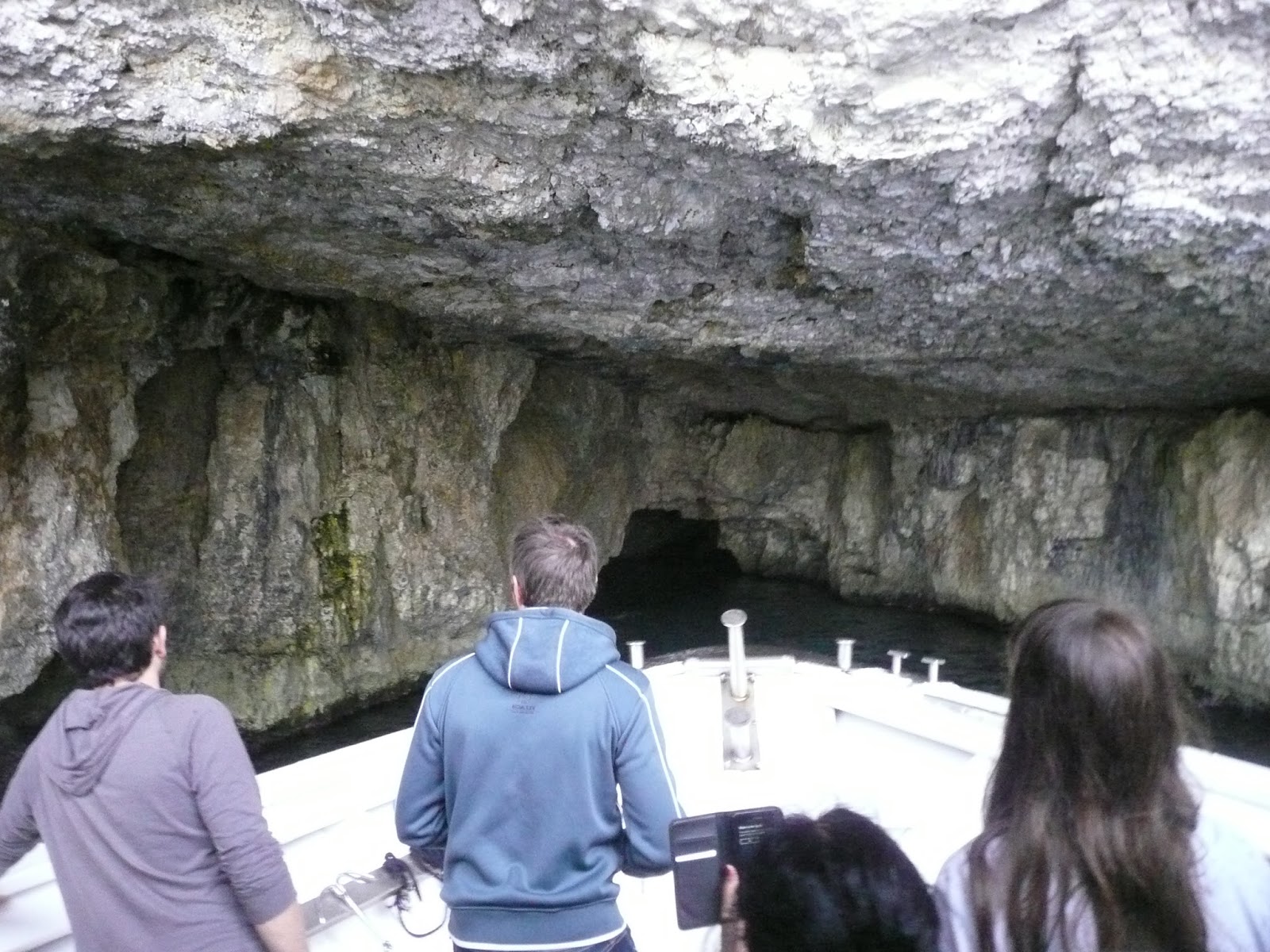
Our swim in the Blue Lagoon was cut short by a very rare Maltese thunderstorm! (This never happens.) We ran back to the boat, but once the storm passed, our return trip was much smoother. The boat made a couple of near approaches to some unusual seaside caves before deadheading back to Sliema.
A closeup look at some of the seaside caves
Despite the odd weather, it was a good day, and we returned to the flat to shower and change for a good dinner and an early bedtime, since the walking and the swim had us all pretty worn out.