We were awake early because the ship weighed anchor and throttled up the engines to reposition for the day. And a beautiful day it was! Clear blue skies, light winds, and pleasant temperatures. I enjoyed my first cup of coffee sitting on the fantail of the second deck, just enjoying the ideal morning.
Breakfast, as usual, was overly abundant. We are all starting to feel fat after almost a week of three large meals every day, plus snacks served every time we return from hiking and snorkeling.

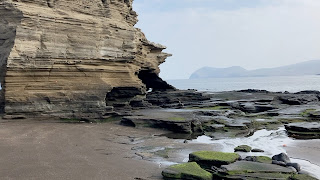
We made a wet landing on a beautiful, sugar sand beach at the base of “Sombrero Chino,” the Chinese Hat. Aptly named, if one simply looks at the shape. Sombrero Chino is a separate island, its own unique volcanic cone, but it is only separated by a matter of yards from the island of Santa Cruz.

The water here was a gorgeous aqua blue and so clear that we could see bottom at least 30 feet or more down. The walk was along black basalt, with sea lions, water iguanas, lava lizards, and the ever-present Sally Lightfoot crabs — not to mention the usual birds, pelicans, penguins, and frigate birds. We were surprised not to see boobies fishing here.

The waves crashing on the shore and the red vegetation (it turns green in the spring when it gets more rain) made an enchanting scene, even if the sun was already getting quite hot.
One group member, Nischala Joy, opted to stay on the beach as the rest of us followed our guide along the well-marked trail by the shore. However, two more, the father and son, Srinivas and Skanda, turned back early on. Alejandra, our tour director, led the other six of us part way, then told us to continue at our own pace to the end of the trail and back. She turned back to see to the others.

When we returned to the beach, we could see the other four standing in knee-deep water as two sea lion pups were playing very near to them. Alejandra urged us all to get our shoes off and wade in, too. We did so quickly.
Park rules are clear that one is not to approach or touch the animals, but the animals have been given no such instruction about us. Alejandra told us to simply stand still and let the sea lions do what they would do. They continued wrestling with each other, but then to break apart and swim very close to us. We were doing nothing to encourage them.
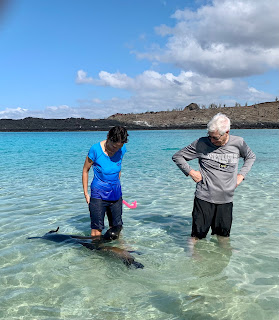
At one point, she even raised up out of the water to sniff the pockets of my shorts, and even wrapped her front flippers around my knee to hold on. When she finished that, she circled around in the water and came back to put her teeth on my opposite ankle — not to bite or break the skin, but very much like a dog plays.
I decided that things were getting a bit rough, so I got out of the water. But the sea lions continued to play with some of the others who remained. The big bull “daddy” sea lion swam close, checking on the situation, but apparently decided that the kids were alright and having fun, so he moved on.
The zodiac picked us up on the beach and we were to do a very quick turn around to get out of our hiking clothes and into our swimsuits and wet suits to go snorkeling. We couldn’t wait to get into that warm, clear water, and we were a bit impatient when Alejandra and the boat driver stopped to pick up some plastic that had floated in from the sea.
The zodiac took us back to the same stretch of water, but this time on the Santa Cruz side of the narrow channel, less than 100 meters across from the beach and path we had just walked. The water was much warmer than we’d experienced the past few days, but we were still glad for our wet suits.
But the water was exceptionally clear — we must have had at least 40 feet of visibility, sometimes more. There was very little current or wave action.
There were so many fish! Probably thousands, in all sorts of bright colors. A school of large fish would swim right at us, ducking under us, and the swarm of fish seemed to go on and on. Sometimes three different schools of fish — three different species — would intersect, each school going it’s own direction, but all of them weaving among the others to stay with their respective groups.
We saw trumpet fish, which we at first thought were eels. We also saw a couple of good-sized sharks — probably 5 or 6 feet in length. They were pretty close to us, but not at all interested in picking on something their own size when there were so many other fish to feed on. One generally treats sharks like this the same way one treats a large, strange dog — you don’t panic and run away, but you keep your distance and don’t try to pet it, either.

There were very large starfish, and even one rather good-sized sting ray — probably 18 inches across or more. I really wanted to see the ray swim, but he was just sitting in the rocks, not going anywhere.
This was an absolutely outstanding snorkeling experience. Some group members who have snorkeled a lot in the Caribbean or Hawaii said that this was way above average, if not the best snorkeling experience they have ever had.
We didn’t mention to anyone that today is my seventieth birthday, but I don’t think I could have had a better birthday gift than this experience. I would have stayed in the water another hour if Alejandra had let us.
Once back aboard the zodiac, and heading back to the boat, we encountered a flock of at least a dozen penguins, clustered together and just floating on the surface of the water. We’ve never seen so many together in one place, and Alejandra said it was quite rare to do so.
After lunch and a siesta as the boat re-positioned, we prepared for an afternoon hike at a spot called “Cerro Dragón” on the northern side of the island of Santa Cruz. The landing was barely dry, because the tide was high and the usual landing spot was submerged. We got off the zodiac onto very wet sand.

On this very hot and sunny walk we saw various cactus, land iguanas, and in a brackish lagoon, three flamingos. The flamingos have been hit hard by global warming, with the El Niño effect having wiped out much of their food source. Alejandra was surprised to find them here.
We also encountered a number of nasty, biting horse flies — the first insects that have really bothered us while we have been here.

Our walk ended with us very hot and sweaty and looking forward to the second shower of the day. But we discovered that the crew, while washing the side of the boat, had sprayed our balcony with a hose and soaked the clothes that we had hung out to dry! We showered, but had to wear some damp stuff.

At 6:30 p.m. we met to have a farewell toast with the crew. We will be sleeping on board tonight and again tomorrow night, but tomorrow’s activities will be in town, without much assistance from the crew. Also, while in port, the crew is very busy re-stocking supplies and preparing for the next group to board. So this is the best time for a farewell.
Mary let the cat out of the bag at the toast, so I got a double shot of aguadiente, roughly translated “fire water,” with my toast drink, which was a hot fruit “infusion,” sort of like a hot cider. It was quite good, especially with the extra booze in it.
All in all, it was a pretty fantastic birthday.