Tuesday, September 30, 2025

San Sebastian

Checking out of the hotel in Bilbao after breakfast, the bus took us through fog under grey skies to San Sebastián. Since the 19th century, when the Queen of Spain decided to build a summer palace by the sea here, this has been a playground for the rich and famous. It continues to be so today.


With a wide beach and well-preserved 19th century buildings along the shore, San Sebastián (or Donostia in Basque) is a center for resorts and shopping just 12 miles from the French border. It was almost completely destroyed by Napoleon in 1813, so except for a couple of old churches, almost everything here has been rebuilt since then.


Starting from the Miramar Jauregia (Palace of Looking at the Sea) we walked the beautiful promenade along the seashore.


Then our tour leader took is through the narrow streets of the old town where there are lots of "cute little shops," but even more pintxos bars. Our tour leader treated us to a small taste of "the best cheesecake in all of Spain" that comes from one bake shop here. It was OK, but nothing like New York Style.


In some free time we visited the oldest church in the city, San Vicente, which has a rich history and a beautiful interior.

Our group enjoyed a wonderful Basque lunch at a small restaurant before walking on along the river to find our bus once again to complete the journey to Pamplona. The thickly forested mountains are very beautiful on most of the route, but give way to more barren terrain as we reached Pamplona.


In the evening we walked around the old town of Pamplona a bit and stepped into a couple of churches. There was a rather large pro-Palestinian rally taking place in one of the plazas. We see Palestinian flags nearly as often as Basque flags.

Monday, September 29, 2025

Guernica

Our bus drove us approximately 25 miles through thick morning fog to the town of Guernica. Today, it's a town of roughly 16,000 people that looks much like any other in this region. In April of 1937 it was the first town on earth to endure the new weapon of arial bombardment, destroying 85% of the structures and killing thousands. Although this weapon was employed repeatedly by all sides in World War II -- climaxing in the nuclear attacks on Japan -- it shocked the world as the first such attack on civilians.


Pablo Picasso's famous painting depicting the destruction of Guernica hangs in a museum in Madrid, but a monochrome reproduction is an outdoor monument here.


Guernica was targeted because it is a traditional center of Basque culture and politics. For centuries, Basque tribal leaders met beneath a sacred oak tree on a hill overlooking the town. Here they would settle disputes and elect their chiefs.


While the original oak is long dead, part of the trunk of an ancient tree is preserved in a monument.


Also, a descendent of the original tree continues to stand near a building where Basque and Spanish politicians still meet from time to time.

Our visit to the Guernica Peace Museum was long and tedious. While the displays about the bombing and its aftermath were well done (though descriptions were only in Spanish and Basque), the sophomoric attempts by the young, 20-something guide to lecture on the philosophy of peace were much, much too long and incredibly dull.


After finally being released from the museum, we visited the Monday Market in a pavilion near the town center. This was poignant because the 1937 attack was timed to hit a Monday market day when Basque people from all around would be in town trying to buy food that had become scarce during the Civil War.


Along the way to our next destination we stopped briefly at an overlook along the coast. A small chapel on a rock in the Bay of Biscay was used as one of the many European locations for the Game of Thrones TV series. We didn't take the hike to see it, but the parking lot was overflowing with the vehicles of those who did.


Narrow, winding roads took us to a Basque village (actually, a number of farm houses scattered widely around a small, very old church). Because the bus could not negotiate the roads any further, we walked from the church to our host home. The church had been tagged with some rather unchristian graffiti.


Lunch was a traditional pintxa of olives and fish, a shot of Basque hard cider, and talos. After corn was brought back from the Americas in the 16th century, it was adopted as one of the few crops that could be cultivated in the Basque hills. Talos are made of corn flour, much like tortillas in Mexico.


Our host demonstrated the technique, then we made our own. We mixed corn flour, water, and a bit of salt to make a dough that was cooked on a gas grill outside the house. For the main course, our talo was topped with our choice of sausages and cheese with a tomato and fish sauce. Dessert talos can be topped with applesauce and chocolate.


On the way back to Bilbao we stopped at the suburb of Getxo where the Nervion River meets the Bay of Biscay. Getxo happens to be the beginning of one tributary of the Compostela pilgrimage walk.


Also here, the unique Vizcaya Bridge was built in 1893 by Alberto Palacio, one of Gustave Eiffel's disciples.


This iron "transporter" bridge was the first of its kind in the world and is one of the few remaining in operation today. 


It's considered part of the Bilbao region's public transportation system and continues to carry passengers, bicycles, and cars across the river daily. It's also a UNESCO World Heritage site.

We got to ride across on the bridge gondola and then returned riding a "Gasolina" -- a power boat that ferries passengers back and forth across the river, and also considered part of the mass transit system.


After returning to the hotel for a few hours of rest, we set out for our home-hosted dinner with a local family. With one other couple, we were paired with hosts Javi and Ana -- a very lively couple about our age. Javi was especially animated, spoke English well, and was a huge fan of American musical theater. The meal was excellent and the conversation did not lag.

Sunday, September 28, 2025

Bilbao New and Old

After flight delays, all 13 members of our group are now here. We had the usual orientation meeting followed by a city tour led by a local guide.


The tour began with a bus excursion around the "new" city (new from the 1870s, that is). Our only stop along the bus ride was at a civic center which was originally a wine warehouse. 


It was proposed as the site of the Guggenheim Museum (see below), but didn't meet specifications for that. Now it has multiple functions, containing a public library, public fitness center with multiple swimming pools, public radio station, city government offices, and more.

One of the swimming pools is on the roof, and the bottom of the pool is glass panels that can be viewed from the ground floor.


Steel pillars needed to be installed to support the roof, and on the ground floor these are covered by pillar sculptures by various artists in all kinds of styles.


After the bus ride, we walked from the "new" city hall (1909) into the "old" town. Walking is necessary because the streets are too narrow for vehicles. While many of the buildings in the old city date back to the 1400s, the facades are newer.


The Basque region is semi-autonomous, with its own language, culture, flag, legislature, tax system, etc. Spain actually has an "embassy" in this city, even though we are technically in Spain. The Basque flag, which looks like a mis-colored Union Jack, flies everywhere. The Spanish flag is seldom seen.


The heart of the old city is a plaza that is completely surrounded by residential apartments on upper floors, with shops on the ground floors. While there are a few shops that provide other goods or services, the vast majority are "bars." In Bilbao, a bar is generally a cafe that serves "pintxas" (PEEN-chahs) to eat, and wine and beer to drink, with very few places to sit. Patrons generally stand to eat and drink.


Pintxas are the Basque version of tapas -- although the Basque people are greatly offended by that comparison. Pixtxas are small portions, but they are generally more substantial than tapas, with lots of meat or seafood and cheese. They are almost always consumed with wine or beer, both of which are unbelievably cheap here. A glass of good wine is usually less than 3 Euros!


On this Sunday afternoon, a major activity in the plaza is the trading of sports cards -- mostly of soccer players. Children, teens, and old men race around with their cards to trade and lists of cards they are seeking. It's clearly important business.


From the plaza, we took a tram ride across town to the Guggenheim Museum. When the Guggenheim Foundation of New York was seeking to build a museum in Europe, they focused on Saltzburg, Austria. But Salzburg delayed the project because of the celebration of a Mozart festival. Bilbao stepped in and offered to build the museum and pay the Foundation several millions of dollars if they would name it and curate the collection.


The projection was that Guggenheim Europe would attract about 250,000 visitors in the first year. The actual number was over a million, and the trend has continued. We contributed to that number by visiting today.


The architecture of the building is a big draw, probably more than the modern art inside. But some of that is pretty interesting, too.


After a couple hours in the Guggenheim, we walked to the Bilbao Museum of Fine Arts, which is in a much less interesting building only a few blocks away. But we arrived at 2:59 p.m., and on Sundays that museum closes at 3 p.m. So we had all of the art we were going to get for the day.

We walked back to the hotel along the river, and rested a bit before meeting our tour leader for a walk to the funicular for a view of the city from the top to the hill. Bilbao is only 10 miles from the Bay of Biscay and has always been a major seaport.


We could see the sea from the hilltop, and also could appreciate why the locals call the city, "The Hole," because it rests in a valley surrounded the foothills of the Pyrenees.

After descending from the overlook, we went to a restaurant the opened especially for us Americans at the unbelievably early hour of 7 p.m. Spaniards never eat their evening meal earlier than 8 or 9 o'clock and often later. So this was a major inconvenience for the restaurant. But they fed us well, nevertheless.

Saturday, September 27, 2025

Pilgrimage to the Past

We have begun another OAT adventure. They bill this one as "Northern Spain and Portugal: Pilgrimage to the Past." We're basically exploring the Basque region of the Pyrenees Mountains and following parts of the ancient "Camino de Santiago" or "Compostela" pilgrimage trail.

We left MSP yesterday afternoon and flew to Amsterdam, then on to Bilbao, Spain. The Twin Cities light rail system is down for maintenance, so we had to take Uber from home all the way to the airport at almost double the cost of our usual arrangement. However, our flights were on time and uneventful -- even if flying across the pond in afternoon rather than evening seems to make jet lag worse.


Arriving in Bilbao, we haven't encountered much that points to a "Pilgrimage to the Past." It's a bustling and modern metropolis. On a beautiful September Saturday afternoon the "centro" (city center) was full of people shopping and enjoying glasses of wine at the many sidewalk cafes. It seems people are really dressed up for a Saturday!

No program for us until evening, and some of our group members have been delayed by missed flight connections. So the two of us walked along the river and on some of the main streets, fighting to stay awake. We did enjoy a nice meal at a little hole-in-the-wall cafe.

Tomorrow we will walk into the "old town," and perhaps that will begin a pilgrimage to the past.

Saturday, June 7, 2025

Sinaia

The Biblical Mount Sinai was where Moses received the Ten Commandments. But the Romanian mountain of the same name (sin-EYE-ah in Romanian) is a popular ski resort in the Carpathian Mountains.


A hundred and fifty years ago, in the 1870s, the first modern king of Romania, Carol I, wasn't ski-ing, but he was interested in having a summer home in the mountains where he could escape the heat of Bucharest.

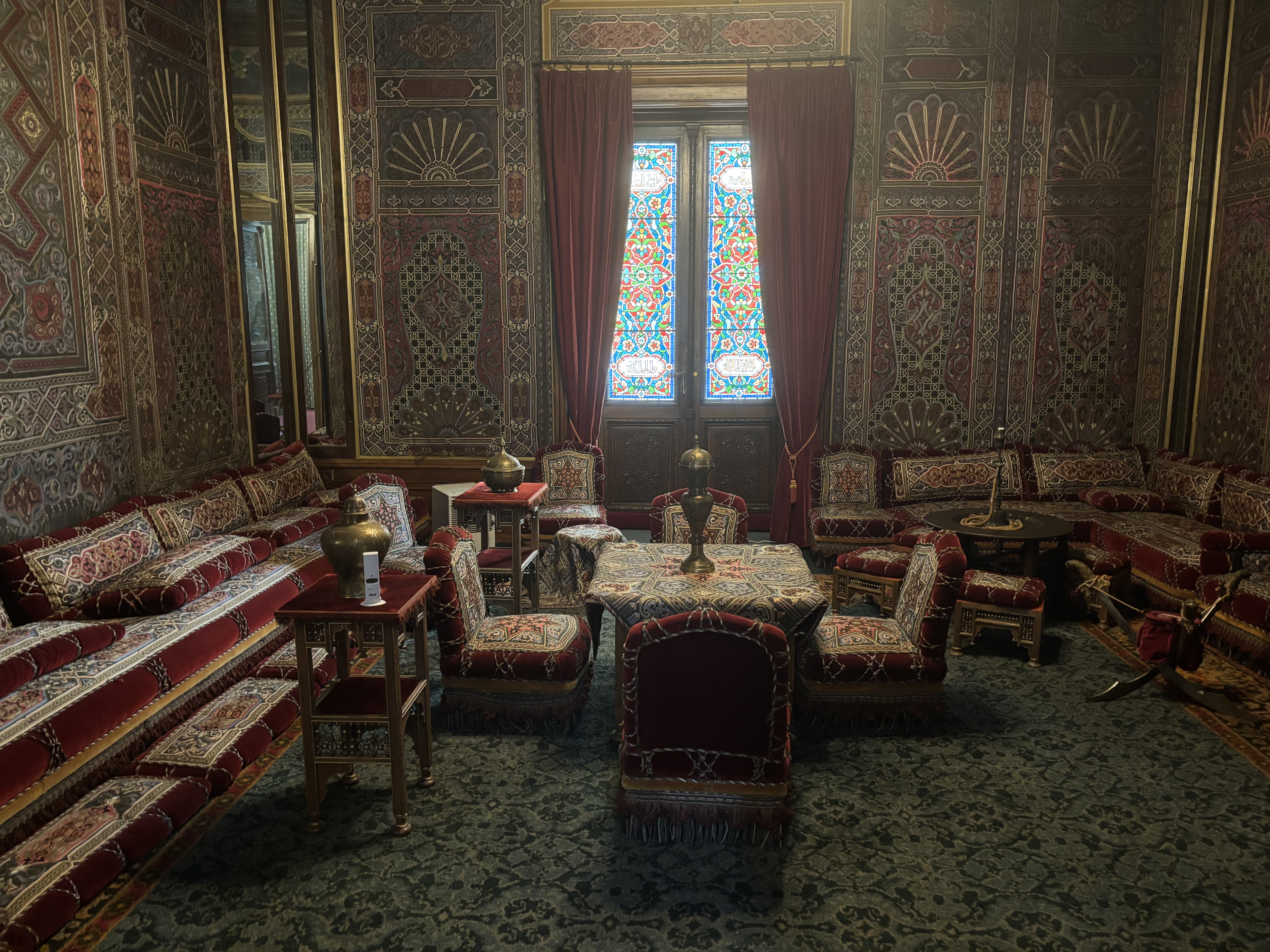
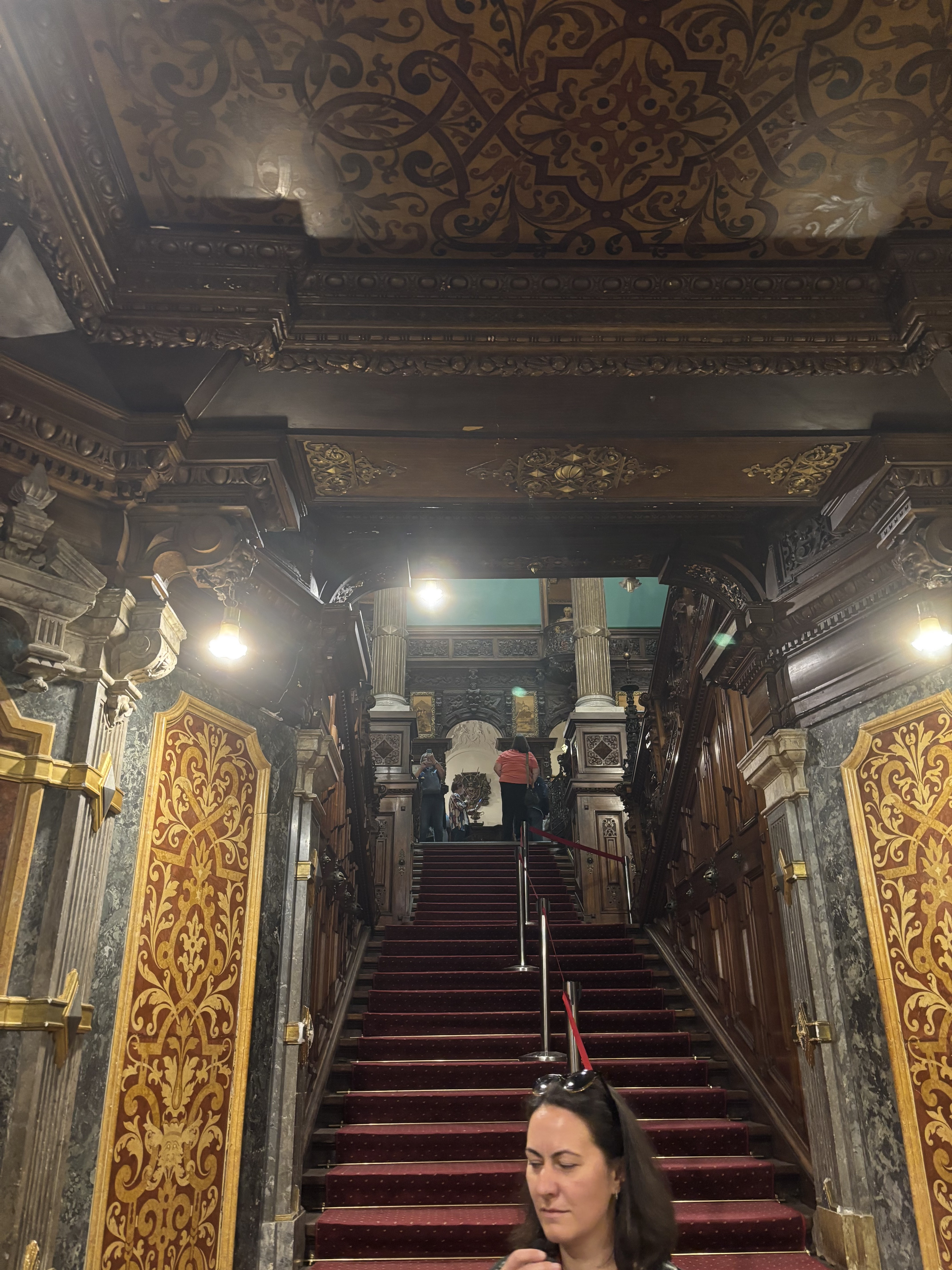
Carol built a modest little cabin in the woods -- by royal standards. The Peles (pronounced PEL-esh) Castle only has about 160 rooms and was built at a cost that would equal approximately $120 million U.S. dollars today.


Born as the second son of a German prince, he had a distinguished career as a Prussian military officer. But after his predecessor -- an Ottoman puppet ruler -- was deposed in a coup, the Romanians turned toward Germany to find an otherwise unoccupied royal who could be recruited to rule.


Karl had commanded Romanian troops in the Russo-Turkish war that had brought about Romanian independence. This earned him the respect of the Romanians, so he was invited to be the prince of the two provinces of Moldova and Wallachia.


In 1881, however, Transylvanian joined the union and Karl (Carol in Romanian) was crowned king of the united country. That's when he really got busy with his summer home project.


Most of the "castle" (it really isn't a fortress in the medieval sense) is lavishly decorated the German Renaissance style. But some rooms are done in French Rococo.


And amazingly, given the recently hard-won independence from the Turks, a couple rooms are in Moorish and Turkish style.


Carol died in 1914 without a direct heir. His wife, Elizabeth, also a German princess, suffered 18 miscarriages and gave birth to only one child -- a daughter who died before her fourth birthday.


The crown passed to Carol's brother. But in the chaos of World War I, in which Romania played a pivotal role against Germany and Austria and as an ally of Britain and France, there was also chaos in the ruling family.


Nevertheless, Romanian royalty continued to use Peles until driven into exile by the communists. For their part, the communists refrained from destroying the castle to use it as a propaganda museum to display the evil, opulent lifestyle of the monarchy.

The communist dictator, Ceaușescu, hated the place and closed it down, but it was restored and reopened as a museum once again after the revolution of 1989.

Back in Bucharest, we enjoyed our farewell dinner with the group. We have to leave for the airport at 3:30 a.m. and we're not looking forward to it.


Friday, June 6, 2025

Bran Castle

Cristian, our tour leader, took us for a walk this morning along a trail on the opposite side of the old town from where we walked yesterday.


The trail was not as wooded, but still very pleasant. There were more sections of the old city wall still intact on this side.


We also passed some of the city's sports facilities: an outdoor ice hockey rink (now drained for the summer, of course), courts for European handball, a large tennis facility, and a high school track oval with soccer fields in the center, rather than the American football field we're used to seeing.


On the way back to the hotel, we searched for and located the old Jewish synagogue in the city. But like most in this part of the world, it no longer functions and stands as a museum. There was a fee to enter, so we passed. We've already visited enough of these.


Because the housekeeping staff at this hotel is incredibly inefficient, our room was still not serviced after most of the morning (in fact, they didn't get to it until about 3 p.m. -- still earlier than the previous day). So we vacated and did some reading in the lobby.


We then decided to take another walk to visit the Orthodox church that we can see in the distance from our hotel room. Fairly recently restored, it has an especially beautiful dome.

The day was growing hot, so we sought out a place in the shade to linger over a beer. We found a craft beer spot, but our selection wasn't the best. Perhaps if our Romanian had been better....


We signed up for the optional tour to Bran Castle, (pronounced Brawn) but it didn't begin until 4:15 in the afternoon. This castle (or at least a sketch of it) was the inspiration for the castle described by Bram Stoker in his horror novel, Dracula.


Stoker used Transylvania and the castle as backdrops, even though he never actually visited here. He also borrowed the name from Vlad Dracula, the brutal 15th century ruler of Wallachia (the Romanian province south of Transylvania). Although this guy never visited Bran Castle either!


The castle remains intact, and was in fact occupied by members of the Romanian royal family until World War II and the communist takeover.


After our tour, we were served dinner on the castle grounds. The menu was duck, followed by something called "Romanian Funeral Dessert." It's much better than it sounds, consisting of whole wheat grain (like an oatmeal), nuts, honey, and rum. The dessert is uniquely Romanian and often served at funeral lunches, hence the name.