Monday, January 20, 2014

Ho Chi Minh City

[After chatting with Ann Highum this week about our SE Asia travels, I am motivated to finish getting my travel diary online. So, several posts dating back to January.]

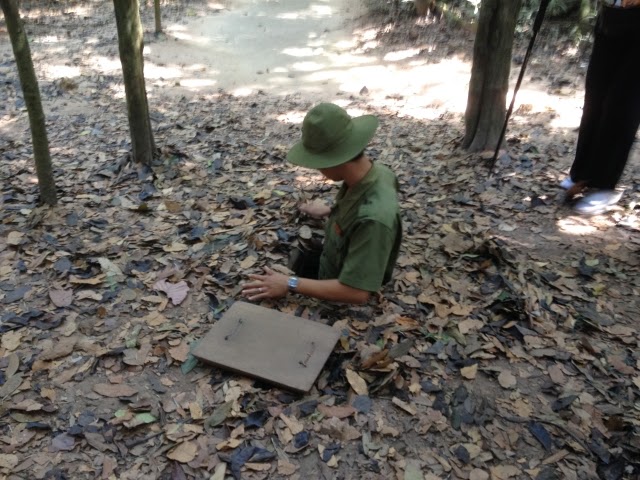
After breakfast at the hotel we boarded the bus for a 2 hour drive toward the northwest, out of Saigon to the area of Cu Chi. There was fierce fighting here during the American War (what we call the Vietnam War), and there is a huge network of tunnels here that were used by the Viet Cong as a command center. U.S. troops were well aware that there were a lot of tunnels here, but it wasn't until the 1990s that the full extent of it was revealed. These tunnels go on for miles, and contained everything from field hospitals to kitchens to officer's clubs. They've dug a few of them out so that fat Americans can fit, even so, one gets the idea that these were not exactly "Five Star" accommodations! The bats buzzing around us served as one indication. Also, we are here in the dry season. In the rainy season, I'm guessing tunnel living was less than ideal.
But the Vietnamese are quite proud of what they did here, and more generally, to drive the Americans out. Our local guide (who strays only slightly from the party line, and then only on the bus when no one can be listening) makes quite a point that there are no foreign troops from any nation on Vietnamese soil today. This came in response to a really dumb question from one member of our group as to whether the American air bases left behind here were still staffed by U.S. personnel! I feel like apologizing to the guide for some of the questions, and for how ignorant Americans are of their own history -- even history they have lived through in their own lifetimes.
We drove back to Ho Chi Minh City to a place near our hotel where we enjoyed a lunch of authentic Pho (pronounced something like "fuah," with a tonal upturn), the Vietnamese national dish. It's basically a huge bowl of chicken noodle soup. There are lots of spices on the table that can be added for extra zip. It was more than I could eat, but Mary snarfed hers right down.

A number of group members went back to the hotel from here, but several of us stayed on the bus to be dropped off at the "War Remnants Museum." This was another heavy dose of propaganda about the "War of Criminal U.S. Aggression." Even though my personal sentiments then and now tended to agree that the war fought here was both illegal and immoral, one still recoils a bit at the simplistic, black and white portrayal of a complex situation. The Americans left lots of stuff behind when they left, so there's no lack of hardware to fill a museum, but by the appearance of things here, and the explanations, Vietnamese people were always entirely passive victims who never fired a shot.
 
One exhibit was exceptional, however. Sort of hidden up on the top floor was an homage to photojournalists who had lost their lives covering the war. Some outstanding photos by American, European, Japanese, and Vietnamese photographers told a much more balanced and much more emotionally poignant story than the rest of the museum. This exhibit had actually been funded by some U.S. corporations, and was a touching tribute to some of those brave souls who, as journalists sometimes put it, "were dying to tell the story."

Armed with an area map, Mary and I walked back to the hotel by way of the gigantic, indoor Ben Thanh Market. We did buy a few things, but mostly soaked up the atmosphere of so much stuff of every description crammed into stalls along the narrowest aisles I've ever seen in a marketplace. There was plenty of tourist bait, but also a lot of foods and clothing items clearly intended for the locals. Because everyone here is preparing for Tet, the lunar new year festival that begins next weekend, this is sort of like the Christmas shopping season in the U.S.

On the way back to the hotel, we walked through the large, "23/9 Park" that runs for several blocks along Le Lai street -- the main thoroughfare on which our hotel is located. We have no idea what the park's odd name is about (there are various accounts from during and after the war), but our hotel room overlooks part of it.

After showering and resting up a bit, we ventured back into the park after dark (it's amazingly well-lit, and teaming with people), and also walked a bit in the tourist area across the park, which largely caters to the young travelers and backpackers. We stopped at a bakery to buy some goodies and sat on the balcony there to watch the people below.

In the park on the way back, we stopped to watch young people playing a game with a sort of overgrown badminton birdie with what appeared to be a spring-loaded nose. They passed it back and forth by hitting it with the bottoms of their shoes, sometimes kicking behind their backs to shoot it over their heads without looking, and other times swinging a foot behind the opposite leg. Fascinating!


It was a bit too early for the nightlife to really get going, but we got a bit of the idea before heading back to the hotel. Tomorrow is another early departure.

Sunday, January 19, 2014

Saigon


We had a leisurely morning, with departure from the hotel not until 9:15.
They say the population of Saigon is 7.6 million people and 10 million motorbikes!
We finally arrived in Ho Chi Minh City (formerly Saigon). The airlines in this part of the world don't have weather delays -- at least at this time of year, when the skies are almost always clear and the temperatures are almost always pleasant. They have inefficiency delays.
Some might recognize the building in the foreground from news photos of 1975. Helicopters landed here to evacuate the last Americans. It's now surrounded by modern skyscrapers.
 The plane was nearly an hour late getting to Vientiane, Laos from Hanoi -- no explanation. Then there weren't enough gates at the airport, so the people coming from Hanoi had to wait on the tarmac and we had to wait in the terminal. There is no direct flight between the capital of Laos and the largest city in Vietnam (go figure), so we had to stop in Phenom Penh, Cambodia. Even though we were continuing on in the same plane, with the same flight number, in the same seats, with only one boarding pass, they made us all get off the plane, taking all of our carry-on luggage. They made us go through security again, even though we'd just gotten off a plane (can't be too secure!) and then stand in line to wait to get back on the plane we'd just gotten off of. The flight attendants were very courteous, and were eager to help us find our way back to the same seats we'd just left (like we couldn't remember where they were).
 
Roman Catholic cathedral in Saigon, packed on Sunday evening.


But Saigon is an amazing place. The international airport, at which we arrived, is the former Tan Son Nhat Air Base, built by the Americans, and still bearing evidence of anti-blast bunkers for aircraft. We were expecting the city itself to be a slum, but it's a very modern, fast-paced place with millions of motorbikes. Our local guide says that American war vets who come back can't believe it, everything has changed so much. The visit to the historical museum was a waste of time, but the walk around the city center, seeing the old French buildings up against the modern high-rises, was fascinating.
 
The old French colonial post office, outside and in.


After dinner at the hotel, our guide offered to lead anyone who wanted to go with him down to the night market, only about a quarter mile from the hotel. Once again, Mark & Mary were the only takers. He bought us a tapioca root snack (pretty bad) and walked us around the various stalls. An important survival skill here is simply learning to cross the street. After about an hour, it was time to head back to the hotel because of an early start in the morning.

Saturday, January 18, 2014

Buddha & War


After breakfast we boarded the bus to visit the Great Sacred Stupa, a national symbol of Laos, and a holy site supposedly enclosing the breastbone of the Buddha as a relic. Interesting, but we took more time there than necessary, especially since I was having a bout of stomach upset and would have been better off nearer a toilet!

Our guide spotted a monk who didn't look to be from around here, and began a conversation with him. Turned out he was a young German who had come for a brief spiritual retreat, but had stayed and was now in his second year. His English was quite good, and he answered questions for us about his life as a monk.

On to the Patuxay Victory Gate -- sort of an Asian "Arc de Triumph" -- Mary and the rest of the group climbed the 200+ steps to see the view, but I wasn't feeling up to it, so sat on a bench. I was soon approached by a young man who wanted to sit with me and chat. I'm afraid I wasn't too friendly at first, because I assumed he was selling something, but he turned out just to be a university student trying to practice his English. He wanted to know about my family and work, and I asked him about his studies. He was studying law, and was hoping for a government job on graduation. However, he indicated that he might, instead, be sent to a rural area to teach high school. The group returned, and I left him, but Mary thought my experience had probably been more interesting than the climb.

Back on the bus, we drove only a short distance to the "House of the Emerald Buddha." (There are, apparently, a number of Emerald Buddhas in this part of the world.) This was originally a private temple for the royal family, but is now a museum of some of the finest Buddha statues in Laos. However, the distinction between a working temple and a museum is a thin one -- we had to take off our shoes to enter, and monks were kneeling on a rug before one of the statues, offering incense.
We had quite a conversation with our local guide, Lou, about what one has to do in order to move to a new residence in Laos, compared to the process of moving in the U.S. He was quite amazed that we didn't have to apply for permission to move, or to register with authorities to keep them informed about where we live!
Our local guide, "Lou."

Across the street was an old monastery, now also a museum, noted for having nearly 7,000 buddha statues. Most were in niches along the walls of a cloister surrounding the central temple. Also present, locked in a separate area, were hundreds of Buddha statues that had been destroyed by invading Siamese in the 19th century. Most had been decapitated. 
Apparently, even if one is Buddhist, desecrating your enemy's buddhas is an acceptable way of humiliating those you've conquered. We also learned that all buddhas are not created equal, and that some statues are too holy to touch, while others are venerated by touching. It's all pretty complex.
Lunch was at a place called the Lao Garden, and while the cobwebs in the rafters and light fixtures gave us pause about the possible state of cleanliness in the kitchen, it was some of the best food we've had on the trip. Even better, instead of the usual watermelon for dessert, we were served our choice of several flavors of ice cream. Mary was one of the few brave enough to try taro flavor, and it was actually quite good.
We continued on to a place called the COPE Center, a rehabilitation facility for amputees who have lost limbs to the millions of munitions (mostly unexploded cluster bombs) that still litter northern and eastern Laos, along the former Ho Chi Minh Trail. A sobering exhibit and documentary film (produced by Canadians for PBS) explained that the U.S. dropped more bombs on Laos (supposedly a neutral country) during the Vietnam conflict than it had dropped on Germany and Japan combined during WW II. Hundreds of people, mostly farm children, are killed or maimed by bombs every year to this day. Yet the U.S. does not take responsibility because, officially, there never was a war in Laos. Very sad.

Mary and some others were dropped at a local market, but didn't stay long. I returned to the hotel, with most of the group, to rest and recoup.

Friday, January 17, 2014

Vientiane


We didn't have to get up early this Friday morning, so we had a bit of leisure time to get our bags packed for today's flight. We also had time to Facetime back to the U.S. and see our granddaughter, who was just getting ready to go to bed for Thursday night, their time. 
The grounds of our hotel made a great spot for wedding photos.
Morning over the Mekong from our hotel.
Once packed up and checked out of the hotel, we took the tuk-tuks one last time into Luang Prabang, where we visited the Royal Palace Museum. Laos actually has three royal palaces: One here in Luang Prabang, one in Vientiane, and another in the southern part of the country. This is not because one king needed three houses, but because Laos was three separate kingdoms with three distinct ethnic groups until it was conquered by Siam, and later by the French. The last king to live here was executed by the Communists in the 1970s. The house is largely intact, with many of the original furnishings, including the former king's cars -- several Lincolns and an Edsel! No photos were allowed, unfortunately.
Palace exterior. Unfortunately, no photos allowed inside.
Following the museum we walked to a local bakery for a light lunch, then met the bus for the trip to the airport. 
One last view of the Mekong at Luang Prabang from the bakery where we ate lunch.
The flight was only about a half hour, but the local airline still managed to serve us a snack -- pretty amazing compared to U.S. airlines! Our hotel is well situated near the heart of Vientiane (which should more correctly be Vien Chan, but the French spelled it their way), a city of some 700,000 people. After a bit of time to unpack and check email, etc., our local guide took us on an orientation tour of the neighborhood. We learned how to cross streets here (carefully, there are no traffic lights) and where some of the key landmarks are. The U.S. Embassy is virtually behind our hotel!
Looking across the river from Vientiane into Thailand at sunset.
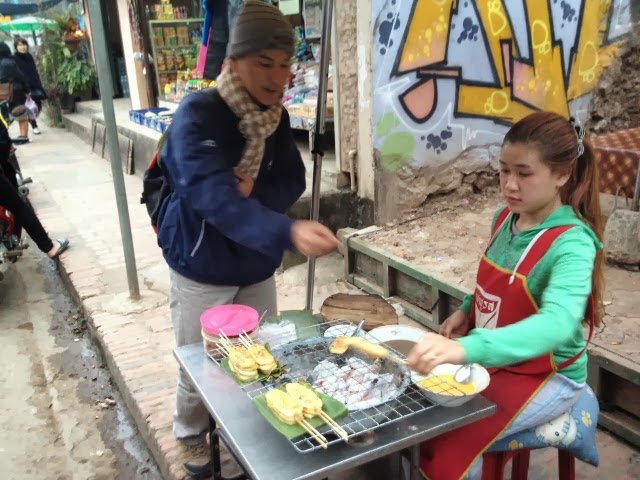
We also walked to the bank of the Mekong River, where we could look across to Thailand on the opposite bank. We saw yet another royal palace, but this one only from the outside, as it is now a government building used for offices and diplomatic receptions. Along the way we happened upon a mobile vendor set up in a parking lot, preparing egg crepes. The local guide bought a couple fresh off the grill, cut up into bite-sized pieces for the group to share. They tasted a lot like French toast.
The crepe maker at work.
Along the river is a night market, as well as groups doing aerobic dancing or jazzercise. Many people were walking along the levy, exercising or just enjoying their Friday evening. We walked back a different route through city streets, seeing a number of restaurants of every nationality, the performing arts center, and the big five-star hotel in town, all from the outside. Our dinner was served at the hotel, another huge rice and stir-fry meal with several different dishes. By the time it was over, the evening was far gone, and we retired to our rooms.
Statue of King Anouvong, the last to rule at Vientiane, offering his hand in friendship towards the Thai side of the river. (Something of a fiction, as he actually died fighting them in 1829!)

Thursday, January 16, 2014

Hmong Village

We were up very early this morning to take part in a traditional Lao ritual of offering alms to the Buddhist monks. Very early each morning, local people prepare rice for the monks, in addition to the morning preparation for their own family breakfast. When a gong is sounded from the temple, people line the streets, sitting or kneeling, with a basket of rice. The monks, in their saffron robes, march around the streets single-file without stopping. People grab balls of rice from their basket with their bare hands and toss one into each monk's bowl as they pass. The poor sit along the same route with a bowl or basket, but with heads bowed and hands pressed together. The monks donate from what they have just received in order to share with the needy.
We nearly froze in the tuk-tuk in the morning chill. When we arrived in town, our local guide had prepared mats on the sidewalk for us, with a low plastic chair and a basket of rice on each mat, along with a nice Lao scarf that we needed to tie over our left shoulder to indicate that we were giving alms. Three groups of monks came by -- there must have been 50-60 in all. One woman gave away her whole basket on just the first group. I was stingier, and had a lot left. As a life-long Lutheran, I had a perverse urge to say, "The body of Christ, given for you" to each passing monk as I put a ball of rice in his bowl!
After seeing to the monks, we walked to "the Lao Starbucks" -- a neighborhood stall selling ultra-strong Lao coffee mixed with sweetened condensed milk, straight from the Carnation can. It was actually pretty good. We got to "chase" it with a glass of hot green tea, which was less good. And for our one dollar, we also got a Lao "donut" -- an oddly shaped piece of deep-fried dough that one dipped into a bowl of more straight condensed milk -- also not bad.
We looked over a number of other breakfast options on offer along the street, but did not partake of fish on a stick, water-buffalo liver on a stick, or other delicacies (there's more food on a stick here than at the Iowa State Fair!). One thing our local guide did invite us to try was deep fried sweet sticky rice on a stick (not bad, but it would take about a dozen of them to make a meal) and we got to peal and eat a tamarind (not much fruit for the effort of getting to it, but supposedly a natural laxative, which I suppose is a plus).
Next we visited the morning market, and as we entered we were given an assignment to buy a particular item, and provided an appropriate amount of Lao money (about 8,000 Kip to the dollar -- yes, all of those zeroes belong there). The assignment was written phonetically in English letters, so we had to go around and ask for this thing without knowing what it was we were actually supposed to be looking for. The local guide warned us that ours would be difficult to pronounce. We did the best we could, but came back pea pods when we were supposed to have had rice noodles. Fail.
The market had the usual interesting stuff found in a third world food market, but with a few extra wrinkles like plastic bags full of buffalo blood at the meat stalls, and an unusually large assortment of catfish heads. We were told this is where the locals shop, but there were a number of items targeted to tourists (English labels and unusually high prices on food goods wrapped in plastic are tip-offs).

We went back to the hotel for a full breakfast, and to pick up the few slackers who chose not to get up before dawn to feed the monks. We then set out again, this time in the motor coach rather than in the tuk-tuks, for a long drive to a rural village. The things we bought in the market were contributions to the home-hosted meal coming up at lunch. We made a stop along the way at a nice looking farm with some picturesque fields and rice paddies, as well as a baby water-buffalo. The people had, of course, not expected company, and they did not quit working in the field when we descended upon them, but they seemed very friendly and proud to show off their farm. They graciously answered even the agriculturally-challenged questions (from group members who clearly had not grown up anywhere near Iowa) as interpreted by our guides.
 
On to the village (a project of Grand Circle Foundation) where we were met by the "head man" and his assistant. After some opening pleasantries, he took us to the area where Grand Circle had donated some hand looms, which allowed women of the village to learn the weaving trade. Table runners of every color and pattern were available for purchase, but only table runners -- nothing else. I suggested they add some place mats to the inventory, but I'm not sure how this translated. We also got to see the water project, that allows families to share a number of water taps around town, rather than walking hundreds of yards to the river with buckets. Poultry also seemed important to show us.
 We met and chatted as a group with a 70-year-old man, sitting in his yard making baskets. Through the guide he told us that he had always liked Americans back during the [Vietnam] war, and "he's glad we came back." (Of course, it's known as the American War here, not the Vietnam War). We also spent some time at the local blacksmith's shop (not really a shop, more of a canopy in the yard. The bellows for his fire were unlike any I'd ever seen: Two wooden tubes standing about 4' tall with what could have passed as a broom handle sticking up in the middle of each. By alternately raising and lowering the handles (sort of like a pair of old fashioned butter churns operated in opposite phase) a continuous stream of air was directed into the hot coals to heat the steel. Today's project was fashioning some rather serious-looking jungle knives from fragments of broken leaf spring from a truck. The man's wife was making handles and sheathes from bamboo.

The head man demonstrated a rather ingenious trap, made from bamboo and wire, designed to attract wild birds to a bait, and then snare them for eating. When asked what sort of birds they were trying to catch, the answer was, "whatever will take the bait." Omnivores!
Finally we reached the school, which is a two room affair with one teacher and about 26 students in grades one and two (for grades 2-5 students walk to the next village). Classroom management seemed not to be a high priority, and the little girl who took my hand and brought me into the classroom as my "hostess" was particularly naughty during the Q&A time with the teacher. Some in our group thought it terrible that one teacher had to have 26 students. These people obviously haven't visited an elementary school in the U.S. any time recently. Mary tried teaching "Head, Shoulders, Knees and Toes," and the children enjoyed singing it, but appeared to already know it.
 The second room in the school is the "library." It has lots of donated children's books in English, but the children mostly only read Lao. There are also eight computers, but they don't appear to be fully operational, and are probably not appropriate technology in this situation.
After the school visit we had a visit to a Hmong home, with a long Q&A translated by our local guide and photos of the man, his wife, and his brother, all in traditional dress. The man's younger brother also performed for us on a traditional instrument.

After yet another opportunity to purchase textiles (we found some this time), we returned to the Head Man's house to help prepare the ingredients we had brought. This was done on a wok over an open fire on a concrete slab in front of the house. The Head Man treated us to some local baiju as the preparation was underway. We removed our shoes to go into the house to eat, and the meal was supplemented by a large spread of food prepared by the family. It was quite good.
 Back on the bus, we drove a short distance to the Kuang Si Waterfall. My expectations were low, but this was quite a nice series of falls, separated by pools of clear blue mineral water that reminded us of Iceland's Blue Lagoon. There were swimmers (mostly college-aged Australians on university break). We enjoyed the hike and the people watching. The bear sanctuary was interesting, too.

We both fell asleep on the bus on the way home, so opted not to go back into town in the evening for dinner. We took a walk outside the hotel grounds, did some reading, and generally relaxed.
Wednesday, January 15, 2014

The Mekong


We are both farther north and higher in altitude than we've been to this point, and the damp, cool weather is a bit more brisk than we prepared for in the wardrobe department. We awoke to thick fog and temps in the upper 50s/low 60s this morning. Breakfast is outdoors. Good thing the coffee was hot. At least we had a hot shower in our room -- some in our group complained that they couldn't get hot water. The rooms have air conditioning, but no heat.

We left the hotel a bit after 8:30 a.m. by tuk-tuk and drove about a half hour to a village where paper is made. We got the whole tour and our group actually made a sheet, decorated with real leaves and flower pedals. There was, of course, a shop adjacent. In fact, the entire little town appeared to be a string of shops selling fancy papers and/or locally made textile goods. Our guide chatted up a family having breakfast a short way off the street, and four of us with the guide were invited to sit down to join them. We tasted sticky rice which we dipped in eggplant, fish, or water-buffalo skin. The egg plant was good.

Next, we walked down to the Mekong River bank and boarded a boat (on which the family running it appeared to live). The motor launch took us up river for a good hour and half through the hills of Laos. We were surprised that there were so few settlements along the river -- the land appears almost unpopulated. Also, aside from a few small fishing canoes and a flotilla of other tourist boats like ours, there was virtually no river traffic.
We stopped at a village where the specialty is the fermenting and distilling of rice. A sweet rice wine is made by fermenting a rice mash with yeast in a clay jar. After a couple weeks the wine is poured off, and the remaining mash is then put into a still to make something very much resembling Chinese baiju (white lightning). This is frequently bottled with a scorpion, snake, or other livestock in the bottle, similar to the worm in a bottle of tequila, only considerably larger relative to the size of the bottle. We tasted a small free sample, but did not buy. Others in our group did.


The village also featured a fairly ornate temple complex and a plethora of textile shops, including some where young children were operating the looms. We had to hope that this was only because our visit happened to fall on a Buddhist full-moon holiday when school was not in session.

We re-boarded the boat and continued up river to the "Buddha Cave." This riverside cave was once thought to be home to a river spirit, but has apparently been exorcized by adding a couple of thousand Buddha statues. Apparently some monks placed one large statue here, then locals attempted to fill the place by bringing in their own, in all sizes and descriptions, pretty much putting them anyplace that they could fit. There were so many tourist boats here that they almost needed traffic control, and the dock was no more than a pile of floating bamboo that made disembarking interesting.

We were fed lunch on the boat on the way back, apparently cooked by the boat driver's wife. She was not an excellent cook, but we didn't starve. With the swift current, the downstream trip took only a fraction of the time. Most of the group re-boarded the tuk-tuks for the trip back to the hotel, but Mary and I walked  the town a bit, seeing some beautiful river views and interesting French colonial architecture. Most of the fine old colonial homes are now converted as restaurants or guest houses. We caught the hotel shuttle back and had about 45 minutes of rest before the next group adventure at 5 p.m.

The tuk-tuks took us into the town once again to a beer garden overlooking the river. We bought a large bottle of the local beer to share, and we were treated to bar-b-cued duck with a hot mustard dipping sauce. Our guide had also purchased a large bottle of red rice wine at the village shop this morning, and shared it with those who were not beer drinkers.

We were also treated to the preparation of a local delicacy frequently served as an appetizer or with beer prior to the evening meal: duck's blood. This was somewhat different from the duck's blood I'd had in China, which was cooked and gelatinous in texture, eaten with chopsticks. This blood was mixed at the table with a duck broth, roasted and chopped duck innards, and spicy green herbs, similar to cilantro. After sitting for several minutes to thicken, it was eaten with a spoon. I found it better than the Chinese version, but not something I wanted to chow down on.

Having finished our appetizer, we walked a few blocks to a nice restaurant for our evening meal, consisting of soup, egg roll, white rice, and three stir-fry dishes -- similar to other meals we've had here. The local guide insists this is not tourist food prepared to American tastes, but that much Lao food is not spicy. He also insisted that a large family meal would also consist of rice with several dishes like this. The difference is that we've been eating a large family meal twice a day on this trip, while Lao families might only have such a meal once a week or so. The meal ended with ice cream, a first for our time in Southeast Asia.

The tuk-tuk ride back to the hotel was quite chilly with the wind in our faces, and we were glad to get under warm blankets in bed.