Saturday, May 25, 2019

Big Bus

This morning we left our gullet behind and transferred back to a bus for the long overland trip to Antalya. Since we are down to only 9 travelers, a 46 passenger bus was a bit much, especially on very steep, winding mountain roads.
Sunrise through the porthole in our cabin
One woman stood up to take a photo out the window, and fell over. She injured her knee and had difficulty walking the rest of the day. It may be a more severe injury that will keep her in pain the rest of the trip.
At our first pit stop, a couple hours down the highway, we visited a hot-house farm. There are hundreds of acres of land covered by these semi-permanent plastic tents. Beneath them, tomatoes, peppers, cucumbers, and any number of other fruits and vegetables being grown. They look even bigger on the inside than they do from the outside.
Near lunch time, we stopped in the city of Kaş (pronounce “kosh”). This was a very charming little seaside resort town. Old houses of a fishing village had been converted to shops and restaurants.

Unfortunately, the shoppers in our group lost themselves in the whole atmosphere. We were supposed to be back on the bus by 11 a.m., but Mark and Mary were the only two who made it on time. We waited 25 minutes for the rest of the group to arrive. We’ve never had that happen on an OAT group before.
Finally, we got everyone on board and moved on to the city of Demre where we were served a huge lunch, with our choice of kebab meats. After 3 days of eating big and sitting much on the gullet, this much food was the last thing we needed. However, none of us seemed to constrain our consumption.

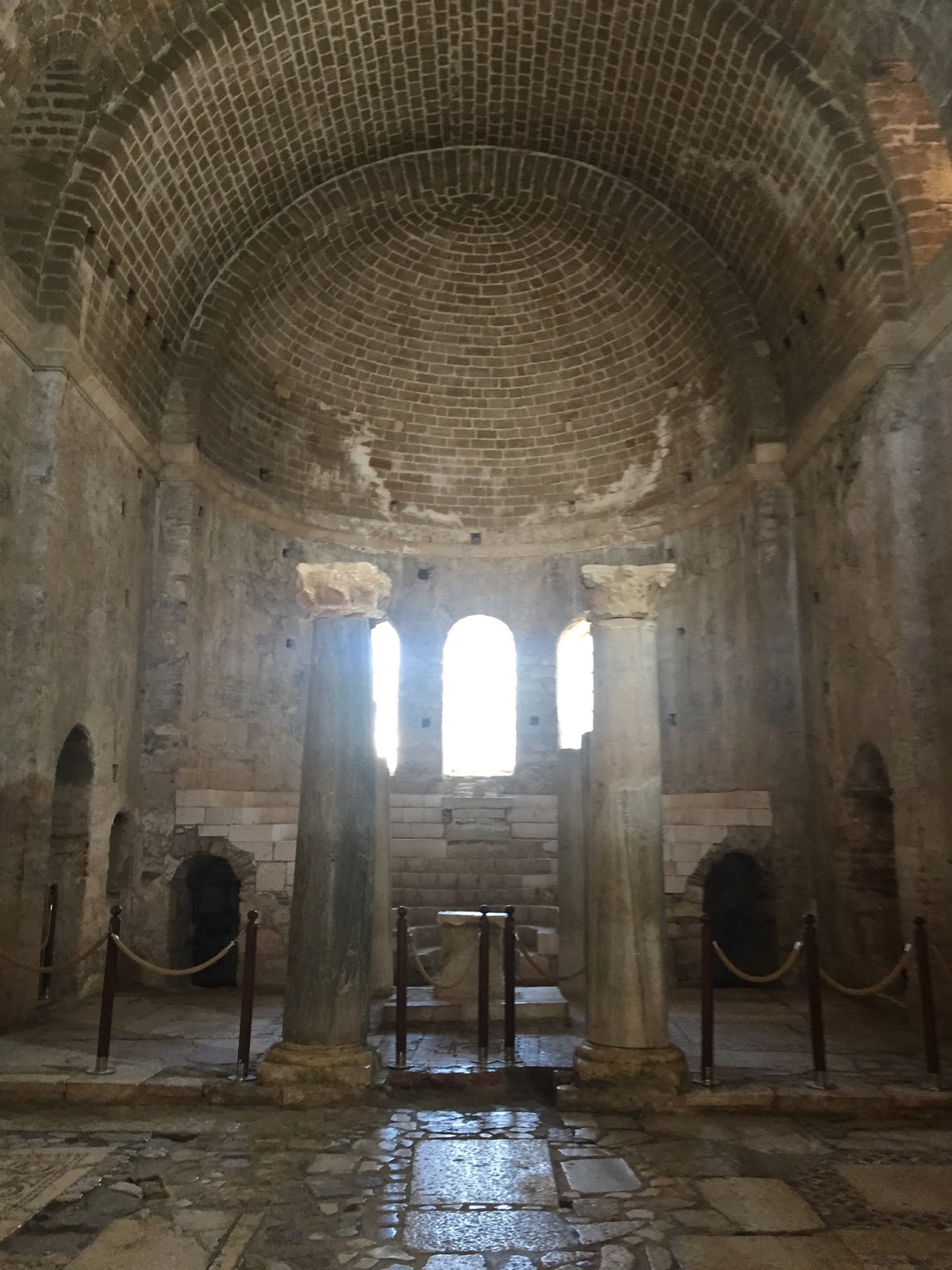
Just a short walk around the corner from our restaurant were the ruins of the Church of Saint Nicholas. This part of town is built over the ancient city of Myra.
The church where St. Nick actually preached has not survived, but this ruin is still well over 1,000 years old. Many of the frescoes are remarkably preserved.
Nicholas is especially revered in the Orthodox tradition, and many Russian tourists flock here.
On the road again, we finally reached Antalya by late afternoon. The long public park that follows the shoreline is quite impressive. Our hotel is deep in the Old Town, near the harbor, and is a remodeled block of old Ottoman houses. It’s nice to have some space again after four nights in a cramped sailboat cabin.
The group enjoyed yet another huge meal at the hotel. Tomorrow only breakfast and dinner are provided — we think it will be good for us to start skipping a few meals!
After dinner, we took a walk along the harbor and saw a waiter from a local restaurant putting out table scraps on the ground. He banged a fork on the china platter loudly, and about 20 cats came running from all directions for the free meal.
After that entertainment, it was time for bed.


Friday, May 24, 2019

St. Nicholas Island (updated)

Promptly at 6 a.m. the gullet engines cranked up and the ship was underway. We left the cove where we had been anchored and headed out into the open Aegean Sea. The sea was not terribly rough, but this boat is small and angle of the waves and wind was such that there was quite a bit of rocking. Mary resorted to motion sickness medication, as did some others in the group.
By 8 a.m. we once again entered sheltered water between the mainland and a small island. As soon as the anchor was dropped, breakfast was served. Then five of us plus Ersin, our tour leader, transferred to the dingy for the short hop over to the island for some exploration.
Officially named Gemiler Island, it is known locally at St. Nicholas Island — even though there is no evidence that Saint Nicholas ever set foot on it. However, a monastery dedicated to him was established here in the 6th century AD, and the ruins of this Byzantine monastery are what we came to explore.
The ruins are fairly well preserved. One of the churches still has frescoes visible on some protected walls, even if earthquakes have collapsed the roof.
A hungry cat and several loud goats accompanied us as we explored a very large, rectangular water cistern. This structure also had a collapsed roof, but the heavily plastered walls indicated that they could once hold water.
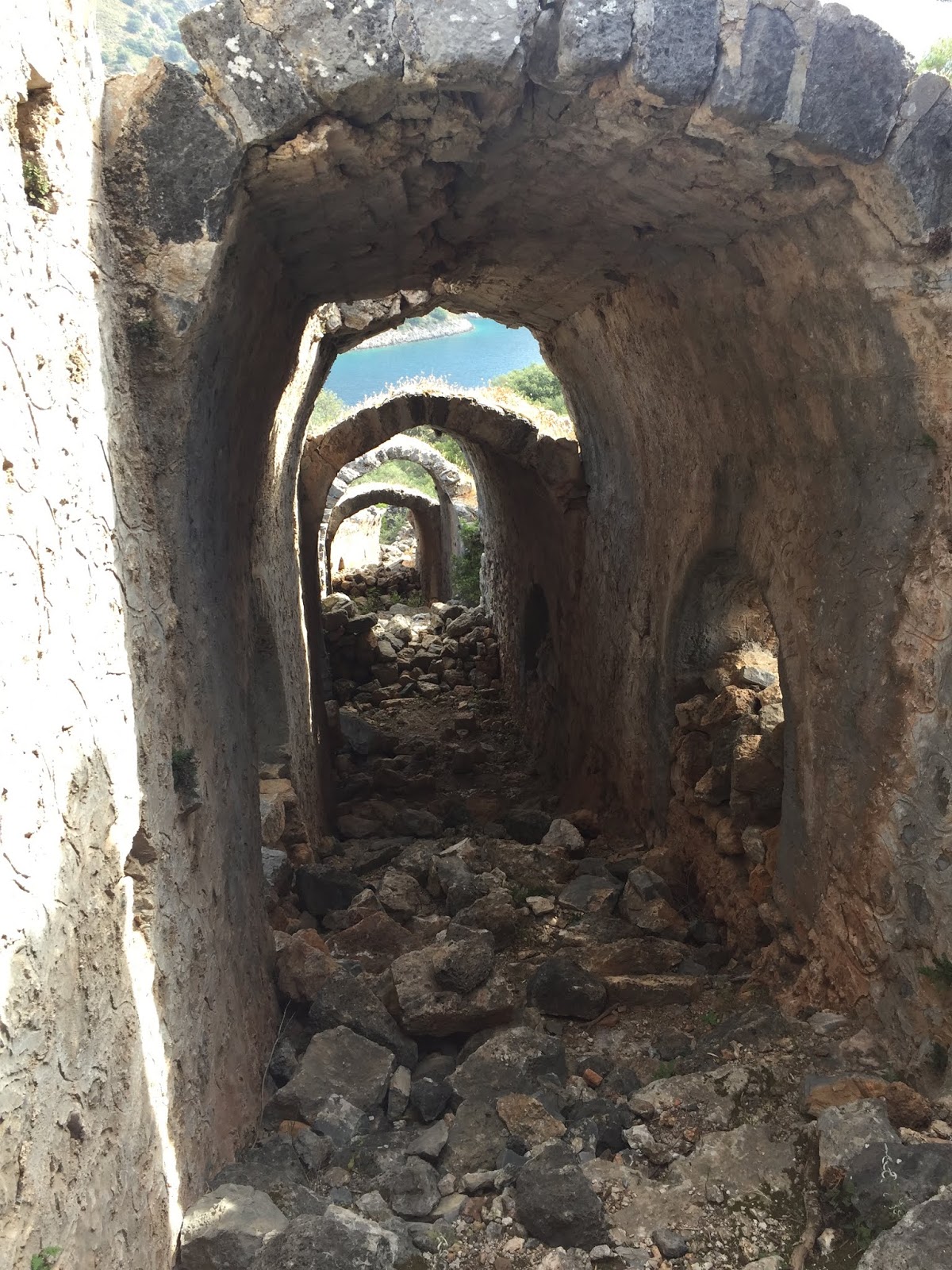
A “tunnel” of arches allowed monks to climb from the lower monatery to the main church, at the top of the mountain, without exposure to sun or rain. Much of it is intact.
The main church itself still has mosaics visible in the floor, though the structure is quite ruined. The view from the summit was spectacular. On this bright, sunny morning we could see paragliders in the sky, launched from a 6000 foot mountain several miles away.
After returning to the gullet we had our final opportunity to take a swim in the Aegean. The water was not warm, but after the initial shock, quite pleasant.
After lunch, the dingy shuttled the entire group to the mainland shore to board a van that took us to Kayokoy, a “ghost town.” In 1923, as part of a treaty ending a war with Greece, Greece and Turkey agreed to a sort of ethnic cleansing program.
Although Greeks had lived in Anatolia since the Trojan Wars celebrated by Homer, 1.5 million ethnic Greeks were told they had only days to pack up and leave for Greece — a country most of them had never seen.
(A half million Turks were also deported from Greece and sent to Turkey, but most of them had not been in Greece for 2500 years. Also, Turkey is a much larger country and had an easier time assimilating them.)
This “ghost town” was a Greek city of roughly 35,000 people that was completely abandoned 100 years ago. The amount of vandalism, destruction, and decay that has occurred in just one century is a clue to how more ancient cities became ruins.
The van took us on to the resort city of Fethiye, a place bustling with tourists from all over the world, and hundreds of gullets and other boats docked here to take them on excursions much like the one we will soon complete.
A few remained at the gullet, which had come here and docked while we toured the ghost town. But most of us continued with the van to the city center.

Our tour leader took us to a rather unique fish market. It is surrounded by restaurants. One goes to the fish market, picks out a fresh catch, and takes it to any of the surrounding restaurants which will prepare it. The restaurants make their money on a service charge, side dishes, and drinks.
We also went to a supermarket, where the tour leader needed to pick up a few groceries for the gullet’s cook. Supermarkets in countries around the world are always fascinating to visit.

From here, we walked ourselves back to the dock and to the gullet. Once again, our tour leader had a DVD movie for us to watch. This one was much better than the one yesterday. It was a documentary biography of Ataturk, the father of the modern Turkish republic.

Before dinner, the gullet left the dock and anchored in a quiet cove across the bay. But we will return and disembark early in the morning.

Thursday, May 23, 2019

Day of Hiking (updated)

Today our tour leader offered two hiking experiences in the Anatolian hills near the Aegean Sea. The first, in the morning, was alonger venture of about 2 miles over some fairly rough terrain.

Ersin, our tour leader, was personally excited about this one, but he was actively discouraging participation by some of those in the group for whom he thought it might be a bit too strenuous.

In the end, it was just Mark & Mary, accompanied by Ken and Kerry, a couple about our age from Texas. The dingy delivered us to shore, then the gullet got underway and moved around the peninsula to meet us in another bay, where we would end up.
The hike was as advertised — not so bad starting out, though it was up hill all the way. And rather challenging on the back side, with lots of loose rock and difficult footing coming down.
For our efforts, however, we had some spectacular views. We encountered the ruins of the ancient Roman city of Lidea, which have not been excavated. This gave us a good idea of what these sites look like before archaeologists arrive and restoration begins.
Along the way, we encountered a couple of cisterns, dug by shepherds to collect and store rain water. These probably dated back 100 years or more, but are still in use today.
We also visited a shepherd’s hut. It was clear that this shepherd is expecting visitors, as he has sort of a little shop set up to sell his wears — generally spoons he carves from olive wood, goat bells, and knitted items.
His wife served us a wonderful sage tea, and because Ersin had called ahead (even shepherds in the hills have cell phones nowadays), she had baked several loaves of bread for us to take back to the ship. It was still warm from the oven when she brought it out to us.
The gullet picked us up, and we discovered that those left behind had not been idle. As they sat at anchor, several “market boats” were making the rounds. These pull alongside and sell everything from ice cream to jewelry. They had done quite a business alongside our boat, and even more came by as we had lunch.
Our afternoon hike was shorter and on easier terrain, so in addition to the four morning hikers, three additional members of the group came along (2 others stayed on the boat all day).
A highlight of this hike was encountering a very small village. These folks were obviously not very prosperous, but there was a little mosque they had built (the nicest building in town). Other than the goats, however, there was nobody home. Every house was shut tight. Apparently they all have jobs elsewhere.
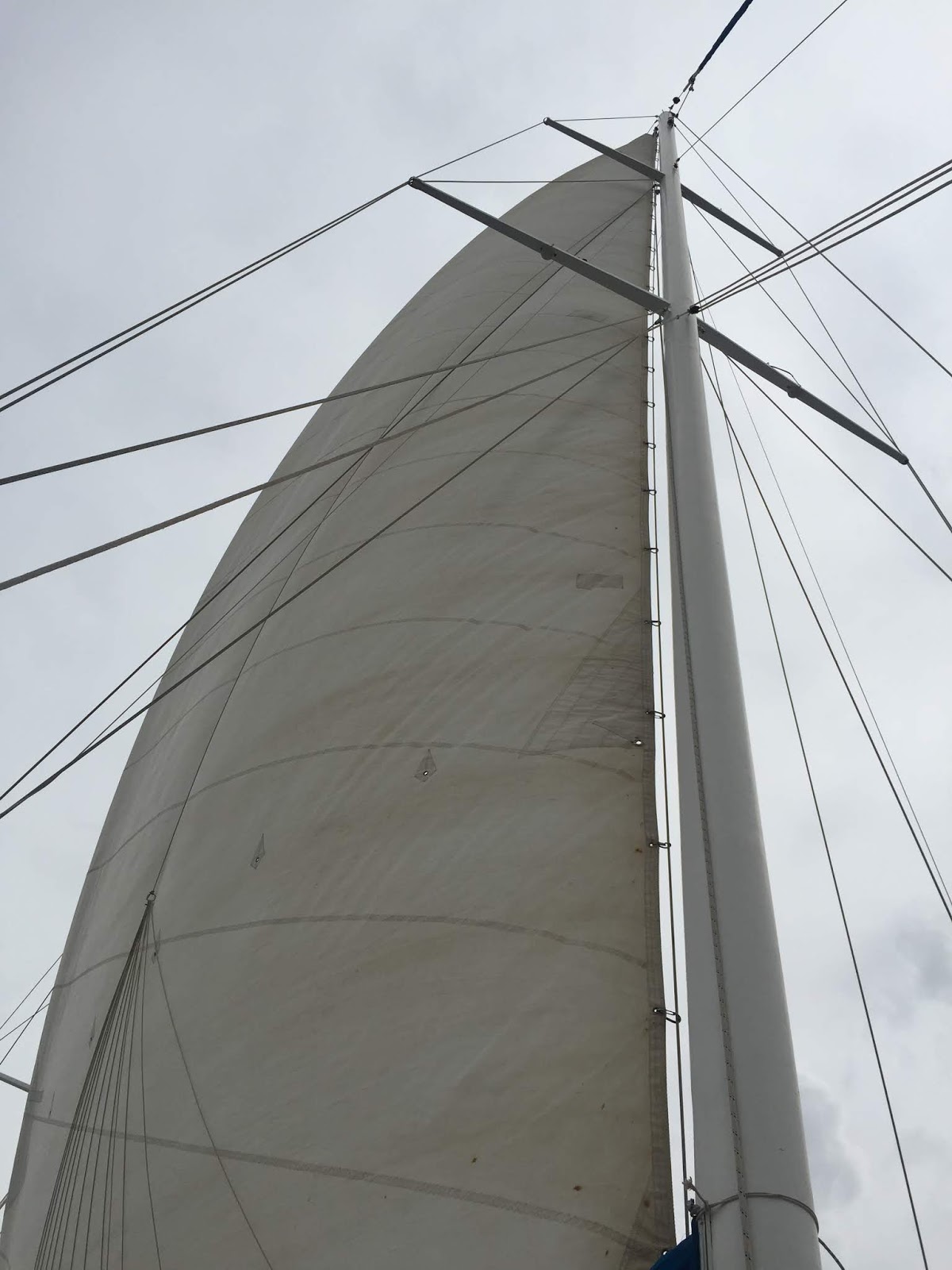
When the walking was done and we returned to the gullet, the captain had the sails raised, and we moved with the wind to our next destination. It was very pleasant to cruise along without engine noise, but after a bit, the wind died.
After “tea” but before dinner, Ersin insisted that we watch a video DVD he had about a 10th century BC temple site recently discovered in Anatolia. Although we won’t have a chance to visit, it is a very significant find that is changing understandings of the development of agriculture.

Unfortunately, the room was hot (windows had to be closed due to a thunder shower) and the movie was poorly done (and in Turkish with English subtitles). Most of the group fell asleep, and we finally had a “mutiny” where we all left before the movie was over.

The rain stopped and we ate dinner on deck, again followed by conversation before retiring.

Wednesday, May 22, 2019

Kounos (updated)

At 5:15 a.m. the engines of the gullet roared to life, and since they are almost directly beneath our cabin, so did we. Though we stayed in bed for another 45 minutes or so, there was no getting back to sleep.

But despite fears of cold showers or other inconveniences, getting ready for the day was actually quite pleasant. The only complication was that the boat was rocking a bit with the waves, as we left our cove and ventured out into the open sea. But we soon got our sea legs.
It was a beautiful morning on deck, with a cool breeze but bright sunshine and good coffee. Breakfast was abundant, and before we had finished the boat anchored in a new bay. We were met there by a smaller boat that took us on a winding path through a tidal salt marsh up the River Daylon to the site of ancient Kounos.
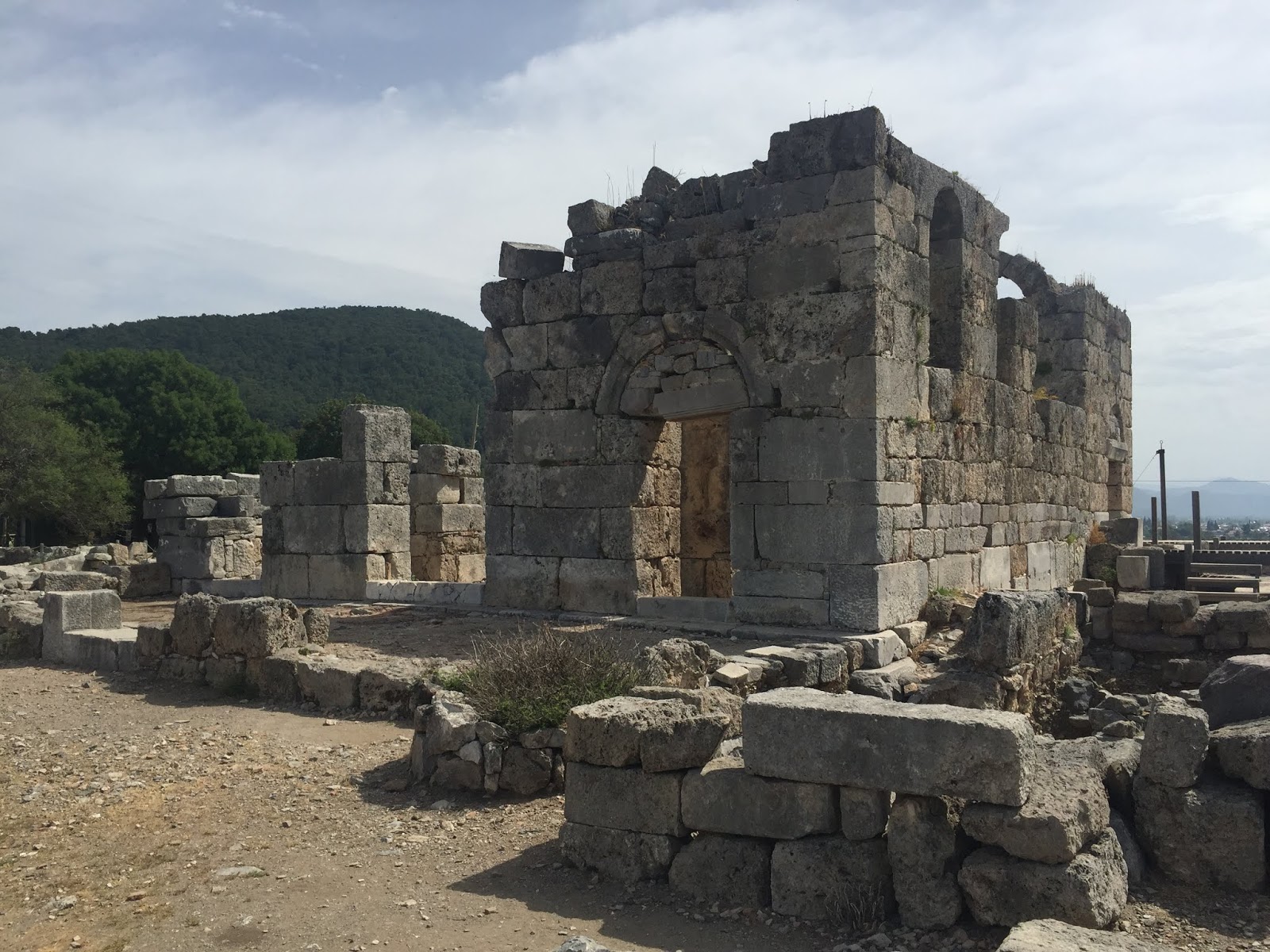
Kounos has a long past as a settlement, but about the 6th century BC the Greeks turned it into a thriving seaport city with a city wall, acropolis, temple to Zeus, and theater. The Persians took over less than two centuries later, but they were displaced by Alexander.
Most of the current ruins date from Roman times, with some later, Byzantine additions. Like Ephesus, the port had to be abandoned around the 6th century AD because of river siltation.
The site is quite well preserved, and not very crowded. There was one other tour group, and a few couples. Other than these, a number of turtles and several sheep, we had the place to ourselves. Though the sun had grown hot, we explored as much as we could.
On the way back to the boat, a Turkish couple had set up a small stand in one corner of their pomegranate orchard and were selling fresh juice, ice cold. It was unlike the pomegranate juice we get at home — thicker, darker, and much more flavorful.

The river boat had circled around during our tour, and met us at the other end of town. On the way out, we observed a necropolis high on the mountainside, overlooking the river, with several 2nd century BC “temple” tombs carved into the rock.
We returned to our gullet for a late lunch, then lounged on deck with our books as the engines started once again for another journey out into the open sea. We continued east until “tea time,” when we dropped anchor very near shore in another isolated cove.

The water here was so clear and blue that we could see bottom quite clearly to a depth of more than 30 feet. Several of us went for a swim, though the water was rather brisk in temperature. A pair of sea turtles shared the cove with us, and one came very near the boat to entertain us.
Every meal aboard the gullet has been large and delicious. All dishes are of Turkish origin, heavy on vegetables and fruits. Eggplant and yogurt make frequent appearances on our table. Our dinner this evening was no exception to this.

The group lingered at the table for some after-dinner conversation, then we retired. That afternoon of lounging around had made us all quite tired.

Tuesday, May 21, 2019

Rugs (updated)

Oriental rug sales pitches are the same all over the world. The group is shown into an area where a few people — usually women — are seated at looms, weaving rugs. Next, the silk worms are displayed. Then the group is ushered into a room, seated and served tea, and several guys start unrolling rugs onto the floor with great ceremony. Then the hard sell begins.
We have been through the same routine in China, India, Egypt, and possibly a couple other countries. They all run together. We knew this was rug day on the itinerary. We brought books to read. The sales guys quickly got the message that we weren’t buying. But the group stayed through lunch, and several rugs were sold to others in the group. The rug guys had an OK day.
After lunch, the bus drove us inland to a small city called Mugla (pronounce MOO-lah) that doesn’t see a lot our tourists. This is the most “liberal” part of Turkey, and there were very, very few women with head scarves. The people could have been in any American city.

Our tour leader took us through an area of small shops and cafes that were entirely catering to locals. That didn’t stop us, and others in the group, from buying things. A shoe repairman even glued a small rip in my shoe for nothing.
At the edge of this area we entered a courtyard that now comprises sort of an artists colony. A man who “marbles” paper demonstrated the process. We’d not seen anything like it. It involved a pan of water, with pigments applied to the water surface.
The artist manipulated the floating pigments with a smal stylus. Then, a large sheet of paper was carefully placed over the water surface, and after a few seconds, pulled off again. The pigments had transferred to the paper from the water. The colors were vivid and the designs rather astounding.
Back on the bus, we completed the journey to Mamaris, a seaside resort town. There we boarded our “gullet,” essentially a two-masted schooner. The boat has beautiful teek decks, and a very pleasant main deck for sitting and eating and talking. The cabins are quite small, but functional.
The gullet left the dock and moved to a cove across the bay, from which the sights and sounds of Mamaris were still very much with us. Loud techno-rock from one of the night clubs sent a pounding beat across the water. Dinner was on deck, and quite good. But as the music from shore continued, we needed to resort to earplugs in order to sleep.

Monday, May 20, 2019

Ephesus

We visited the ruins of ancient Ephesus back in 2012 as part of our Greek islands trip, But sites like this never wear out — we went today, and I could go back again tomorrow. It is a step back in time, and a realization that people 2000 years ago lived very much as we do today, in many ways.

It was not as hot today as it was seven years ago, even though we were visiting more than a month later in the year. The crowds were equally thick on both visits.

One thing different was that the main theater was closed back in 2012, as it was still in the process of being restored. We got to go into that theater today, and to fully appreciate its size (it seats more than 30,000 spectators).

After a nice lunch at a nearby hotel, we continued on to the ruins of the Church of St. John. The thought of going back here had made me cringe, as we had an absolutely terrible guide here back in 2012. Our tour leader today did a much better job, and even made the site interesting.
Church of St. John
The promoters of tourism here insist on conflating John, the Apostle, with John the Epistle writer, with John of Patmos who wrote the Revelation. Bible scholars have long known that these are not all the same person (John was a common name in the ancient world, just as it is today).

After finishing at the church, we drove to the Ephesus Archaeological Museum.. This was not on our itinerary in 2012, and may not have even existed then. It appears to be a fairly new museum, and the exhibits are limited to artifacts found here in Ephesus.
Artemis
The collection is quite interesting, especially two large representations of the goddess Artemis (Diana in the Roman pantheon) who was the primary deity of pre-Roman Ephesus. It was well worth the time.

After a bit of down time back at the hotel, we took our very oversized coach (we have a 46 passenger bus for 11 travelers and one tour leader) and drove about a half hour out into the hills to a winery.
A winery in a country in which the primary religion forbids consuming alcohol seems a bit odd, and the wine wasn’t really all that great. But the food was pretty good.
At dinner, we toasted a couple who will be leaving us. One of their mothers had an episode of heart arrhythmia and wound up in intensive care back in California. So they cut their trip short to return home. We hope everything turns out OK, and we are sad that our group will now be only nine.

[Note that we will be without internet the next few days, so posts will be delayed.]