Wednesday, October 9, 2024

Strasbourg

The rain that was forecast, but didn't happen yesterday, during the day, came during the night. We had an early train from Luxembourg, and it was still dark and raining when we left the hotel. Good thing the rail station was just across the street! And a good thing we had our umbrellas.

But the rain had stopped by the time we arrived in Strasbourg. Again, our hotel here is just across the street from the rail station. It was much too early to check in, but we were able to drop our bags, grab a map, and set out to see the sites.


Strasbourg is a charming city, apparently spared too much bombing in World War II. However, it was damaged significantly in the Franco-Prussian War of 1870. So while some buildings are really old, most are just old.


The cathedral is really old, dating back to the 12th century. Even 80 percent of the stained glass is original, dating to the 12th to 15th centuries. It was preserved by being hidden in southern France during the war, but was found and stolen by the Nazis. However, it was recovered by The Monument Men (yes, the movie was about real life) in 1945 and restored to the church.


The cathedral is also known for its clock, which is very large and elaborate, but the show it puts on every 15 minutes is underwhelming.


From the cathedral we followed the Rick Steves book on a walking tour along the River L'Ill to St. Thomas church, the largest Protestant church in France. The organ here is very famous because it was played by Mozart when it was new, and by Albert Schweitzer, who was born and raised near here.


We continued on to the "Petite France" area. This was the Medieval "industrial park" of Strasbourg, where water-driven mills and warehouses lined the river, and hides were tanned to make fine leather. The smell from the tanneries made it a much less desirable neighborhood. But now, Rick Steves describes it as "a Hansel-and-Gretel fantasy."


This area was packed with Viking Cruises and other tour groups, and is full of shops and restaurants aimed at tourists. We ate lunch in one of them, trying the local Tartes Flambee, which is really just a very thin crust pizza.

In the afternoon we retraced our steps back to the Strasbourg Historical Museum. We got in for half price for being old, and learned about Strasbourg from Roman times to the recent past. But mostly, the museum focused on the place as a "free city" in the Holy Roman Empire, followed by being tossed back and forth between Germany and France for several centuries, depending on who won the last war.


One interesting object here was a "fire organ" which was played with ignited natural gas, rather than wind. Apparently it didn't catch on.

Another interesting fact from the museum is that Strasbourg fights with Mainz over who gets to claim Johannes Gutenberg and the birthplace of movable metal type printing. Gutenberg lived here for a decade or so, and supposedly experimented with printing while in Strasbourg.


But he was born in Mainz and returned there to publish his famous Bible. Most media studies textbooks give Mainz the win, but Strasbourg has a statue, a square, and a street named after Gutenberg. Today, the square even had a double-decker carousel in operation!

Being so close to the French/German border has given this place a unique identity. The Protestant Reformation was big here, but when the French next took over, Catholicism was reinstated. There was a long history of pogroms here, with Jews being forced out of the city repeatedly. So when Hitler visited, he felt right at home. But so did Napoleon when he came through a century and a half earlier.

In the evening we set out to try the French wine and the German beer that are both equally popular here. We found a little place that served a light supper and enjoyed it before going back to the hotel to rest our weary legs.

Tuesday, October 8, 2024

Luxembourg

Over the summer we found a really good deal on cheap flights to Europe. The cheapest was a flight to Luxembourg. We had no burning desire to see tiny Luxembourg, but with accumulated airline miles and the cheap price, the flights were essentially free. Also, Luxembourg is centrally located, so from there it's an easy train ride to parts of France, Germany, and Switzerland.

The trip to the airport was uneventful, our Delta flight was on time, we had good seats, and we both managed to get a few hours sleep on the flight over. The connecting flight from Amsterdam to Luxembourg was slightly delayed, but only by a few minutes.
Luxembourg has free mass transit, so anyone can jump on any bus or tram and never worry about a ticket. The bus from the airport into the city center was packed full, standing room only. After a slight bit of confusion we found our hotel, only a stone's throw from he railway station.


After checking in, we got on a (free) tram and set out for the old city, which dates back to the 10th century, C.E., but is largely reconstructed after two world wars. Americans are popular here -- there are streets named after Roosevelt and Patton, for example. It's a quaint European city, very walkable, but nothing spectacular is here.


The Cathedral of Notre Dame here doesn't hold a candle to the one in Paris, but it is very pretty. It has lots of very nice stained glass and a huge organ.


The Ducal Palace is still the seat of government, and we got to see the changing of the guard. It's nothing like Buckingham Palace in terms of the show they put on.


The city's ancient fortifications are a UNESCO World Heritage site, and we walked along them. It's very hilly here, which provided natural defenses, as well.

We finally wound up back near the railway station and our hotel where we found a nice little Asian restaurant run by a Chinese family. Nevertheless, we both selected Thai dishes, and both were very good. European price tags would help Americans understand that they actually have it pretty good when it comes to inflation!

Tomorrow, bright and early, we are off to Strasbourg, France by train.

Wednesday, May 8, 2024

Sushi

For our final full day in Japan, we traveled by subway and local train to visit the Fushimi Inari Shrine at the base of Mount Inari. Dating from the 10th century C.E., this shrine is most noted for more than 10,000 torii, or ceremonial gates, all painted orange (or "vermillion" as the promotions all say).


As one climbs higher up the mountain, the gates take on different sizes. It's pretty interesting for the first 1,000 or so, then it gets a bit repetitive.


People come to this Shinto shrine to pray for whatever it is they are wishing for. If the wish is granted, one purchases a torii that is inscribed with a name and dedication. That gate stands until it rots or until the donor is no longer supporting it, then it is removed and replaced by one donated by someone else.


Perhaps more interesting (at least for one member of our family) is that the "messenger animal" for the god of this shrine is the fox. There were statues of foxes everywhere, as guardians of the shrine. The Shinto priests were even selling wooden fox faces that you could write your prayers on, then leave at the shrine for the gods to read and perhaps answer.


As one climbs higher, there are stone altars adorned with miniature symbolic torii and sometimes with candles or incense burners. Many of the altars also had carvings or statues of foxes. But most are not cute, cuddly foxes. As guardians of the shrine, they all look pretty fierce.


After spending a bit too much time at Fushimi Inari, we got back on the local train and returned to Kyoto Station. Across the street from the station is a commercial building where we found a small sushi school on the second floor.


The sushi chef had prepared rice, fish, and other ingredients for us. After telling us something about his life and work, he began giving us a lesson in sushi preparation.


Of course, the difficult parts had already been done for us: Selecting and slicing the fresh seafood, preparing the rice, etc. But he led us through the final assembly. Then we got to eat our creations.

Sushi has never had much appeal for us, but this was really very good. The chef prepared some extras for us so that we could enjoy more. He said that he sometimes makes more than 2,000 sushi in a day as a chef.


Our tour essentially ended with the sushi experience. Several of us went back across the street to the rail station and ascended the six very long escalators that rise to the observation deck.


There were very few people who rode all the way to the top, and the "Happy Terrace." But the view is fine. One can see all the way to Osaka.


The view from up here was probably not quite as good as that from the nearby Kyoto Tower, which is nearly twice as high. But it costs ¥900 (about $5.80 U.S.) to go up to that tower. The rail station observation deck is free and open to the public, even without a train ticket.

From the rail station we took our last subway ride up to the Imperial Palace. We thought we were being clever and using the last of our transit cards, right down to the penny. We didn't realize that this stop was in a different zone than our hotel, so we were each 40 Yen short (about 25 cents each). Once we figured out the machine, we were at least able to get rid of some of our spare change to make up the shortfall.


The palace was the residence of emperors for more than 500 years until the capital was moved to Tokyo in 1869. It is surrounded by more than nine square miles of large, grassy and tree-filled park. In earlier times, there were homes here for lesser members of the royal family.


Even inside the inner wall, the area is spacious, with large gates, imposing waiting areas, a huge audience hall where the emperor received guests, and large ceremonial halls -- some used only once or twice a year.


Interestingly, the actual living quarters of the emperor were not all that large. But they were adjacent to a very beautifully laid out garden with a large pond.

It was about 25 minutes walk back to the hotel in pleasant sunshine with a cool breeze from the north. We stopped at the 7-11 across from the hotel to buy some snacks and get rid of the last of our Yen. At 5 p.m. our group met for our final happy hour and debriefing. OAT gave us each a Japanese fan as a gift for completing 20 trips.


Our farewell dinner was at a restaurant just across the street. It was a traditional Japanese meal with many courses. Most of the food was very good, but we each passed on a few items.

We head to the airport at 8 a.m. tomorrow morning and begin the long trip home.

Tuesday, May 7, 2024

Hiroshima

The group activity for today was visiting (yet another) Buddhist temple here in Kyoto, along with lessons from a monk on Zen meditation. I'm sure that it was beautiful, but we've done Zen instruction before. So we ditched the group today. This was not a spontaneous decision. We had the bullet train tickets days ago.

We made our way back to Kyoto railway station on the subway more quickly and easily than we'd planned. This is the first workday back after the holiday week, and we were ready for big crowds of commuters. We were surprised that the metro wasn't crowded at all. We were also surprised to see lots of school kids -- many as little as kindergarten or first grade -- who were moving through the station, obviously on their way to school, but completely without adults supervision. What independent kids!

Because we got to the station so early, we went to the ticket office and moved our tickets to an earlier train, getting into Hiroshima almost a half hour earlier than planned. We had little trouble finding the tram from the rail station to the Peace Park, but there were conflicting messages about at which stop to get off. We probably walked a bit more than necessary.


The Peace Park is beautiful. The dome monument -- the ruined shell of what used to be the Hiroshima Prefectural Industrial Promotion Hall -- dominates the space.


We walked through the park directly to the museum, where we bought tickets (very cheap) and audio guides (only a couple bucks apiece, but probably unnecessary as everything was in English anyway, and often the audio was just reading what was already on the display).

The museum was very crowded, but with few Japanese. Mostly Europeans and Americans. But aside from the Holocaust Memorial in Israel, we don't recall a museum as quiet as this. There was no talking. It was a very somber place, with emphasis on individual stories of the victims, both immediate and later due to radiation.

There was mention of the fact that Hiroshima was a major military base and an industrial center for war material, but the museum focused primarily on civilian victims.


After the museum, we crossed the Peace Park once again, this time in a more leisurely fashion. There were bus-loads of school groups on the grounds.

Mary had scoped out a restaurant for okonomiyaki -- a sort of Japanese pancake topped with cabbage, meat, and seafood that is a local specialty in Hiroshima. We found it quickly, but it was closed. No reason was given. Google Maps helped us locate two other okonomiyaki restaurants nearby, and both of them were also closed. We don't know if it was some sort of restaurant holiday or what.


We continued walking to the Hiroshima Castle, hoping to stumble upon a restaurant for lunch along the way. We had to settle for an ice cream cone from a stand on the castle grounds. But the "raw chocolate" cone was really quite good, even if very different from chocolate ice cream in the U.S.


The castle was built 1589-1591, but was leveled down to nothing but the stone foundations by the atomic bomb in 1945. The "faithful reproduction" was built in 1958 and the exhibits inside still have a very 1950s feel to them. It's overdue for renovation.


From there we walked toward the Shukkeien Garden. Built in 1620 as the grounds for a villa by a wealthy family, it was opened to the public in 1940. 


The atomic bomb attack destroyed most of the trees and other features. However, many survivors came here because there was water in the pond. So many died here that the garden became a cremation and burial site. Reopened in 1951, the garden now includes memorials to the dead. 


There are giant koi fish in the garden pond, and when a woman started feeding them there was a tremendous thrashing of fins and tails as dozens tried to get their fish pellets.

We continued walking from the garden on to the railway station. We were still looking for restaurants along the way, but found many close in the afternoons between lunch and dinner. It was now after 3 p.m.


But in the railway station food court, we finally found a place that was open and specialize in okonomiyaki! So we got our Hiroshima specialty meal after all. With the spicy sauces added, it was very good and quite filling.

Again, we were at the station earlier than our 6 p.m. train tickets, but we had no trouble exchanging them for a train an hour earlier. We made it back to our Kyoto hotel a bit weary from a long day of walking. But overall, our adventure in independent travel in Japan was a success.

Monday, May 6, 2024

Nara

Today our motor coach motored us a little more than an hour to the south to the city of Nara, which long ago preceded Kyoto as Japan's capital city.


The Todai-ji Temple is a UNESCO World Heritage site and is said to be the largest wooden building in the world. It's built completely without nails, only joined wood.


It houses the Daibutsu -- the largest statue of Buddha in Japan -- a bronze that is 52 feet tall. The bronze was once covered in gold leaf, but a fire destroyed that.


In addition, there are several other huge statues, most made of wood, that stand as guardians to the temple.


There's also a giant bronze lantern on the grounds that is thought to date back to the temple's founding in the mid-eighth century C.E.


And there is a pillar with a hole in the base, said to be the same size as one of the Daibutsu's nostrils. Children climb through it and are supposed to earn good luck by doing so.


One wooden statue is a representation of a long-dead monk who was said to have had healing powers so great that just touching his statue can bring relief from illness. We're still waiting for the results.


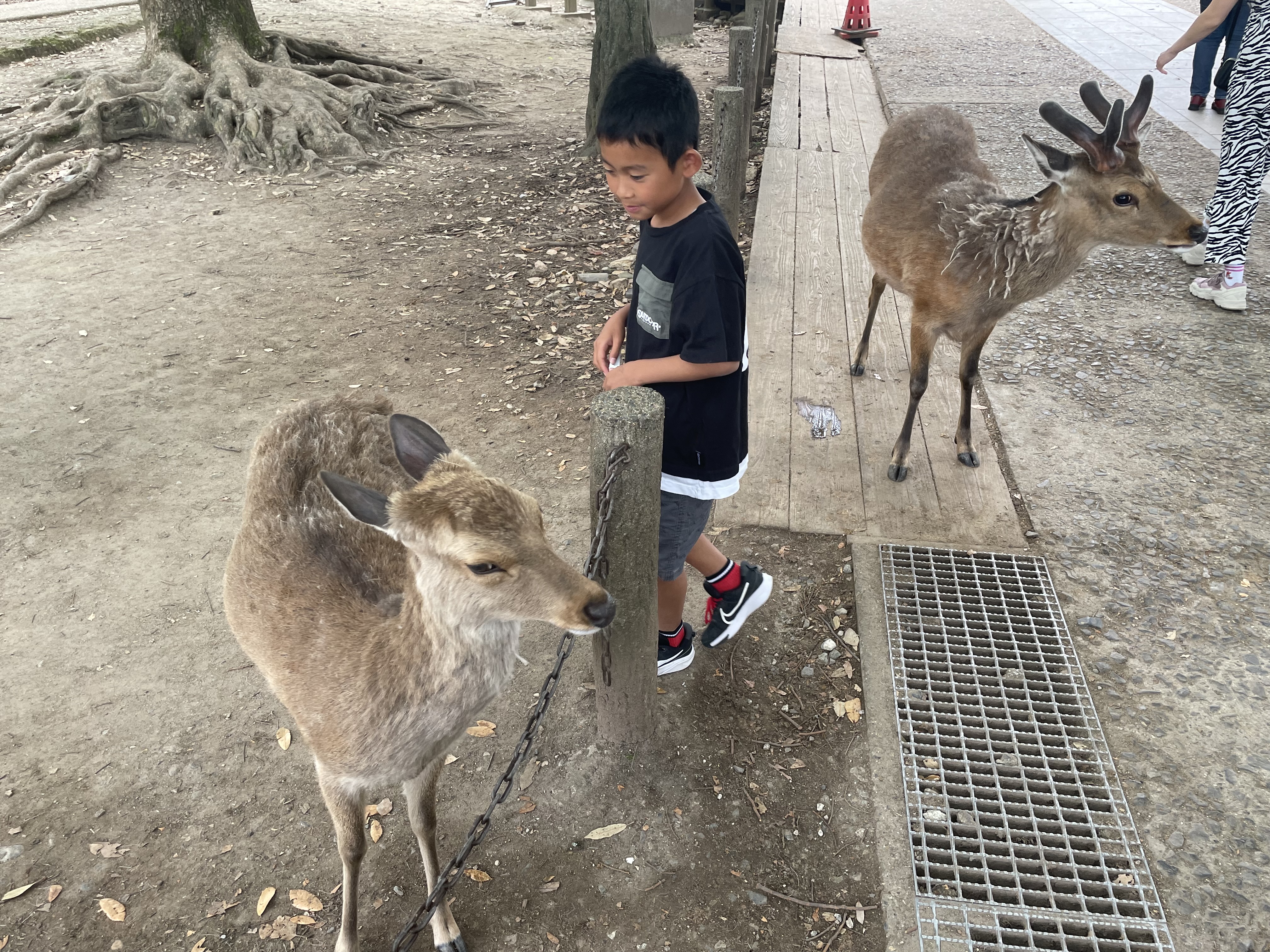
The most unique feature of the park surrounding the temple is the herd of deer that roam free here. These deer are so tame that you can pet them. And if you buy some of the flat biscuits they love to eat, you can be very popular with them.


Unfortunately, they can be pretty aggressive if you happen to be feeding one when another thinks it's his or her turn, or when you run out of biscuits when one of them wants more. One followed Mark and grabbed his shirttail in her mouth to pull him back when he walked away after giving out his last biscuit.


The deer are thought to be messengers of the Shinto god Kasuga, so they get special treatment. They have their own "house" where they can go to bed at night, and another where does go to give birth to their fawns. It's also interesting that the messengers of a Shinto god reside on the grounds of a Buddhist temple. The two religions exist side by side here, with most Japanese practicing both.


We had to walk a bit to get to our lunch restaurant in Nara, but it was worth the trip. The narrow streets and old buildings are a lot like Kyoto, and as we crossed a bridge over a small stream we even got to see a stone boat!


But on the way back to the bus, three members of the group set off walking at a faster pace and got ahead of the group. They thought they knew where they were going, but missed a turn and got lost. Mariko somehow tracked them down, eventually.


We drove back to Kyoto and visited a museum dedicated to tea culture. A "tea master" and her helper staged a much abbreviated tea ceremony for us. Then we were equipped with a bowl and some "matcha," or ground or powered green tea.


We were guided in the mixing of the matcha. The only bad part was that we actually had to drink it. Whether prepared by the "tea master" or by us, it's pretty vile stuff. Definitely an acquired taste. We learned that it takes about 10 years of study to become a tea master, which made us appreciate grocery store tea bags all the more.


After tea, we were released for free time the rest of the afternoon. Some returned to the hotel, others went to an art museum. We elected to go to the Gion district of Kyoto, along the Shirakawa River.

Gion originated as an entertainment district to accommodate the needs of travelers and visitors to a local shrine. It eventually evolved to become one of the most exclusive and well-known geisha districts in all of Japan.


The district still caters to the needs and desires of travelers, but today more with bars and restaurants than with geisha tea houses. (The only geishas we saw were on the street, trying to entice tourists to buy tickets to a show.) From the district it was an easy walk back to our hotel.

Dinner in the evening also involved a bit of a walk, but it was one of the best meals we've had on the trip, including multiple courses of sashimi, tempura, sushi, and even ice cream for dessert!