Thursday, February 6, 2025

Mitla

We had an hour-long bus ride out of Oaxaca this morning to the village of Mitla, the site of a pre-colonial Zapotec city. The Zapotecs were a tribe under the domination of the Aztecs. We were led by a local guide.


Much of the complex was destroyed by the Spaniards and a church was built atop the rubble. But some of the buildings were converted into barns, stables, and warehouses, and thus preserved.


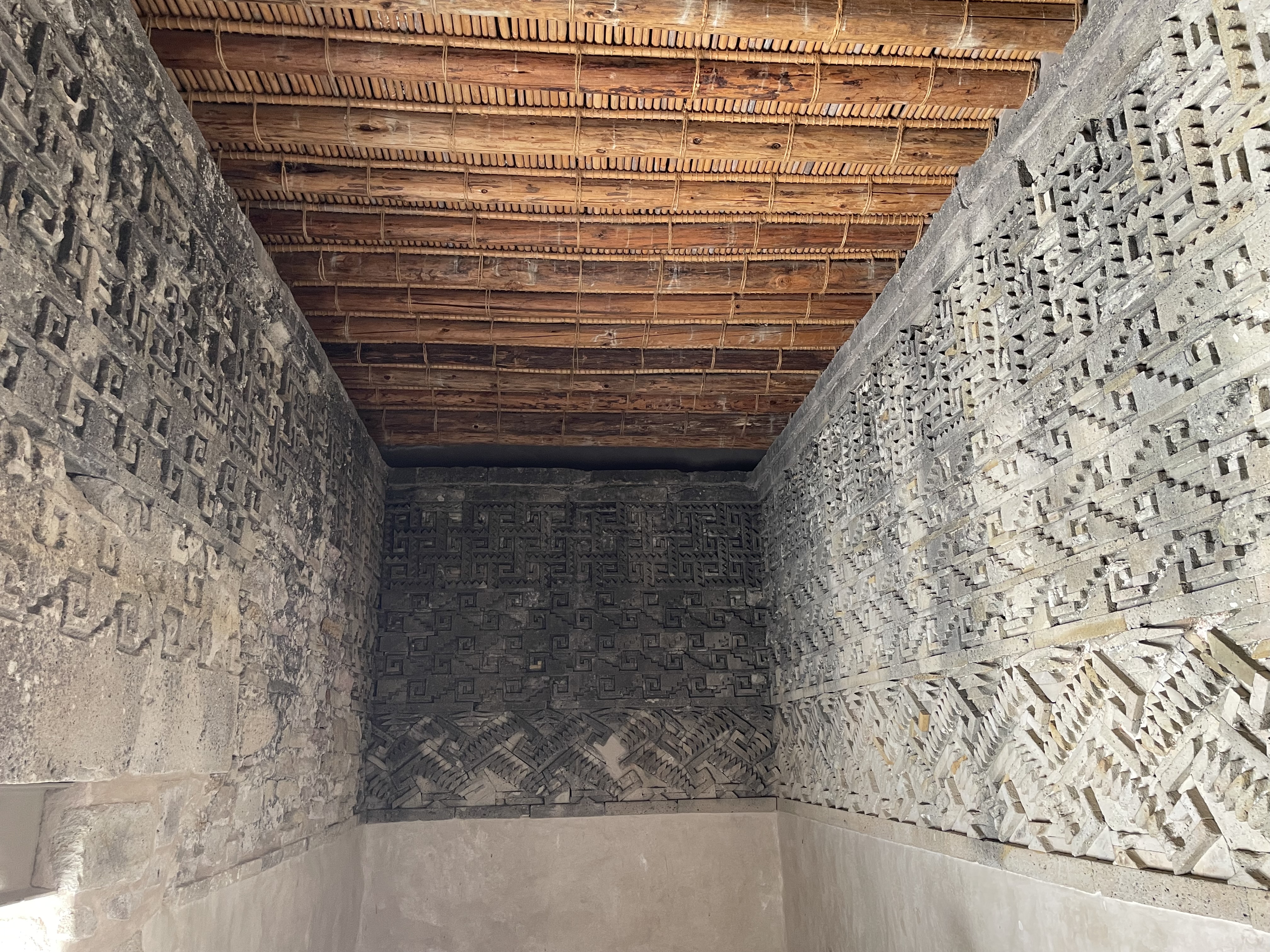
A unique feature of these ruins is the geometric patterns in the walls. Archaeologists agree that these have symbolic religious meaning, but disagree on the precise interpretation of each.

One thing on which they agree is that a major deity worshipped here was a god of earthquakes -- significant in this seismically active area.


Also significant is that these buildings have survived here for more than a thousand years, while the church and other buildings constructed by the Spaniards have had to be rebuilt several times due to earthquake damage.


The geometric patterns are not simply carved into the stone (which would have been difficult enough for a culture without metal tools). Instead, smaller stones were carefully shaped and put together like an enormous jigsaw puzzle to create the patterns.


After our visit to the ruins, we drove a short distance to a restaurant for a really excellent all-you-can-eat buffet lunch, featuring several kinds of mole sauces.


After returning to Oaxaca, we embarked on a walking tour of the mercado (market). As markets in developing countries go, this one was pretty clean, though the aisles were narrow and cramped.


Grasshoppers seem to be a favorite snack food or dietary supplement here, and they were in abundance in the market.


There was a bit of everything in the market (even religious shrines), but among the crafts Oaxaca is known for is leather goods. I bargained for a leather belt and got a pretty good deal. Mary looked briefly for a purse, but didn't find one that tripped her trigger.


The local guide continued our walking tour through the old city center, past the cathedral, and eventually back to Santo Domingo church, which we had walked by last night.


This time, we got to go inside. The baroque decor and extensive use of gold leaf were stunning. However, it was very dark inside, so the photos don't do it justice.


Dinner was to be on our own, but we were too full from lunch to want anything more than a snack.

Wednesday, February 5, 2025

Road Trip

We left Puebla this morning for a long drive across the Sierras to Oaxaca. There isn't much to say about the drive, other than that we got to see an active volcano...


...and a lot of cactus.


We needed to stretch our legs upon arrival, so we walked around the neighborhood. We are very near the old center of the city.


Balam took us on an orientation walk on the way to dinner, and we got at least a glimpse of the old town.


It looks like a marvelous place, and we'll see more in the coming days. Dinner was excellent!

Tuesday, February 4, 2025

Puebla Redux

This morning we had a walking tour with a local city guide. She was quite good, but we have some slow movers in the group, so the pace wasn't very fast.


First stop was the cathedral, but there was a mass going on and we couldn't get beyond the narthex (more on that later).


The walk continued to a small plaza with some old tiles that weren't terribly interesting. But there was also a contemporary mural protesting violence against women in Mexico. That was quite striking.


We then turned down a narrow street called "Frog Alley." The street got its name from the fact that whenever the San Francisco River flooded, the water would come up hill about that far. Flood control measures have stopped that, but it remains a quaint colonial street.


Quaint colonial streets became a theme, and though each had a story, few stand out.


One that did is a street that was lined with doors opening to tiny, one-room studios. This was the artists' street. At 10 a.m., most of the studios were locked up tight. But a few early risers were in their studios painting, and had some of their works displayed for sale.


Another unique street was the market street. In earlier days, this is where Pueblans came for their daily groceries. Now it is full of cheap souvenir shops targeting tourists.


We spent considerably more time than necessary at Talavera pottery studio. It was interesting to see how this pottery is produced, but we've seen similar demonstrations before. The "museum" tracing the history of ceramics around the world became a bit tedious. And of course, some wanted to spend time and money in the shop.


While the shoppers tarried, the rest of the group followed our city guide to the Calle de los Dulces, or "The Sweet Street." This street is lined with dozens of candy stores (though they all seemed to be selling the same stuff).


The patron saint of Sweet Street is Santa Clara -- Saint Clara -- because nuns from a convent on this street are said to be the originators of most of the traditional recipes.


Santa Clara's convent is no longer in business. The nuns are gone. But the confections were tasty!


A house just across the street from the former convent is riddled with unrepaired bullet holes. It is said that the Mexican Revolution of 1910 began here, when assassins sent by dictator Porfirio Díaz opened fire on this house, where supporters of opposition leader Francisco Madero were meeting.


We were supposed to end the tour at the spectacular (so we are told) Rosary Chapel in the Church of Santa Domingo. The entire baroque chapel is adorned in gold, from top to bottom. Unfortunately, a motion picture production company was shooting a period drama that apparently involved a scene of a wedding in the chapel. We got to see many of the very large cast in costume, but the chapel was closed.

The tour completed, the group dispersed for a free afternoon. We did a light lunch and a cold beer by the main plaza, enjoying some leisurely people-watching.


Then we returned to the cathedral on our own to see the interior, now that the morning mass was over. The baroque style is evident here, as well. In some aspects, this cathedral exceeds that of the one in Mexico City.


Puebla's colonial wealth and devotion to the kings and queens of Spain are on display here, as is the devotion to the Virgin Mary and Puebla's fascination with angels.


From the cathedral, we walked to the Casa de Alfeñique museum. This is the home of a 17th century merchant and his family that has been restored and furnished in a manner true to the time period.

The lower floors were for commerce and servants' quarters. The family occupied and entertained on the top floor.


Their wealth was evident throughout, but especially in that they maintained their own private chapel where a priest came regularly to say mass for the household.


After a brief rest at the hotel, we met our tour leader and many group members on an optional walk to the Biblioteca Palafoxiana. Founded in 1646 by Juan de Palafox, bishop of Puebla, it is recognized by UNESCO as the first public library in the Americas, and one of the oldest in the world.


Palafox donated his personal library of some 5,000 books to the seminary he founded, stipulating that they should be made available, not just to seminarians, but to anyone who could read. Today there are more than 45,000 books, including more than a thousand incunabula.

Dinner was included tonight at a local restaurant near the plaza. We had a chicken mole that was quite good.

Monday, February 3, 2025

Puebla

We left Mexico City behind this morning. As we drove southeast, the flat city gave way to rolling farmland, then as we drove into higher altitude, pine forest.

We made a couple stops on the way. The first was at a very new and modern truck stop that had everything you'd find at your interstate Casey's or KwikStar, and more.

The second was at an older, less fancy gas stop where we got a good view of one of the two, 17,000 foot volcanoes that dominate the topography and mythology of central Mexico.

Puebla is an industrial city, and we passed many huge manufacturing plants on the way into town. The largest was a Volkswagen assembly plant that is the largest that company maintains outside of Germany. It seemed to go on for miles.


The heart of the city is colonial and largely well-preserved. There was no pre-colonial settlement here, so no ruins pre-dating the Spaniards. The cathedral rivals that of Mexico City, and the central plaza is beautiful.

Our tour leader took us on a brief orientation walk around the central plaza. We ate lunch at a cafe just across the street from the cathedral. The main course was a cemita, a sandwich local to this area that is generally filled with shredded pork, cheese, or other meat -- usually with avocado and spices. But our cemitas were pretty bland.

After finally getting to check into our hotel room (which is not nearly as fancy as the one in Mexico City) we returned to the plaza and boarded a tour bus. The bus took us around some of the main attractions with commentary in English.


It was a good overview. The big claim to fame here is that the fort on the hill above the city center was the location of the famous battle of "Cinco de Mayo" where Mexican forces defeated the French in 1862.


We just barely got back in time to accompany our tour leader on a walk to a churros shop, where we enjoyed a bag of sugary churros and a couple of hot chocolates for about $6.


The evening rainstorm hit just after we returned to the hotel, so we managed to stay dry. 

Sunday, February 2, 2025

Zocalo

The day began in the heart of Mexico City. "Plaza de la Constitución," popularly known as the zocalo (the foundation) has been the center of this urban settlement since prehistoric times.


The ancient temples that stood here for more than a thousand years were reduced to rubble 500 years ago by the Spaniards. They were replaced by a huge cathedral that took 250 years to complete, and by grand palaces that are the home of presidents and bureaucratic offices today.


We saw only the exterior of these edifices during our morning stop, including the balcony from which the President of Mexico delivers the Independence Day address each September 15.


We also walked by some of the excavated ruins of the "Temple Majore" or Grand Temple of the Aztecs.


We also walked by colonial-era buildings that are sinking unevenly into the drained lakebed that once surrounded this plaza.

From Zocalo, our bus drove us to Xochimilco, where some of that original lakebed remains under shallow water. The Spaniards called this place "the Venice of the New World" because the Aztecs -- and even those before them -- had created artificial islands here for agricultural purposes.


Canals between the islands allowed produce to be brought to the city. On this Sunday of a three-day holiday weekend, the canals were crowded with party barges. Mariachi bands moved from barge to barge to provide entertainment.


The band that boarded our barge was dressed in the traditional mariachi costumes, but precise intonation was apparently not a requirement for membership in this group.


There were even small barges loaded with beer, snacks, and other goods for sale, and a simple wave would bring them alongside.


Back on shore, a group of pole climbers, recreating an ancient ritual of coastal tribes, was also eager to collect coins from those who photographed or shot video. Others were selling woven bracelets -- one could buy one with one's name, or others with expressions such as "F*ck Trump." Tariffs don't seem to be popular down here.

After our somewhat chaotic boat ride, the bus took us to the Coyoacan neighborhood (where we had been on our own the first day). We enjoyed an excellent lunch inside the crowded local market. The tour leader had promised the group a drive past the Frida Kahlo Museum, but that didn't materialize. No worries for us, as we'd already been there.


When the bus dropped us back at the hotel, the two of us made a hurried walk back to Zocalo. Again, with the holiday weekend, the streets were packed with people, who all seemed to be walking in the opposite direction we were heading.


The walk was over a mile, but we covered it as quickly as possible because the Temple Majore Museum would close at 5 p.m. We rushed through the outdoor section in the rain, and then continued to rush through the indoor exhibits.


We didn't realize that, although the last entry was at 5, we could remain in the museum until 6 p.m. But rush we did, still catching most of the highlights of what has been unearthed here, despite Spanish destruction.


The rain was even heavier when we departed, but we only went a short distance to the cathedral where we could stay dry. The 5:30 p.m. mass had just begun when we got there, so the main nave was closed. We sat and listened to the service in a narthex area, then got our look.


We walked back to the hotel for some relaxation, but then set out walking once again to the Bellas Artes theater for the 8:30 p.m. Ballet Folklorio. We are really getting our steps today! We had "nosebleed" seats in the very back row of the top balcony. The ballet was quite good, with some excellent Mariachi musicians and really fine dancers. But it was too much of a good thing.


Saturday, February 1, 2025

Teotihuacan

An hour-long bus ride into the countryside on the outskirts of Mexico City brought us to the archaeological site of Teotihuacan. The site is dominated by the two massive pyramids -- one for the sun and the other for the moon.


Our local guide was not very good. He rambled without any structure or form to his presentation. So there was a lot of trivial information that we really couldn't process or retain. He also just wasn't very interesting to listen to.


What we did come away with is that these pyramids were built over a long span of time, beginning more than two millennia ago. Smaller pyramids were "buried" by larger and larger structures built on top of them.


The builders were a civilization that pre-dated the Aztecs, and when the Aztecs came here they found it abandoned. Nevertheless, the Aztecs made it their capital, expanded their empire, and grew the city to a population possibly as large as 100,000 before the Spaniards arrived.

Though there are no written records, it is clear that numerology was important to the builders, with the numbers four, five and 13 being significant. The pyramids are also sophisticated solar and lunar calendars in their alignment with the celestial movements.


After a couple hours of moseying through the expansive site, we went a very short distance for lunch and entertainment by a couple of young women who danced traditional dances in period costumes.

The ride back into the city was even longer due to traffic. This is a three-day holiday weekend in Mexico (the Mexican equivalent of "Flag Day"). So streets were closed for festivals. We were supposed to visit Zocalo, a temple site inside the city. But that will have to wait until tomorrow.


On our own, the two of us walked to Revolution Square where there was a tamale festival taking place. Some of the food looked and smelled really good, but street food is not a wise choice for tourists. We were reminded of that fact when we passed one stall where the vendor was mixing meat in a large bowl with his bare hands.


Late afternoon, our tour leader offered an optional experience of visiting a "pulque" bar. Pulque is a traditional beverage made from the agave plant, but is not distilled like tequila. The alcohol content is also much lower, only 2 or 3%. 


About 14 of our 34 group members took the offer. The pulque wasn't bad, and the cultural experience was priceless.