Sunday, February 9, 2025

Monte Albán

Seems that I skipped a day in my blogging due to fatigue and hot weather. On Sunday we capped the main tour by visiting the archaeological site of Monte Alban outside of Oaxaca.


This Mayan ruin is spectacular! Our local guide was a woman from Denmark who moved here decades ago to work on the digs here. Her knowledge was very comprehensive.


The site has at least 23 temples to various deities. Some of the pyramids can still be climbed. The views at the top are spectacular.


The oldest structures, dedicated to ceremonial art and dance, are at the southwest corner of the temple complex. This site was active for more than 1,000 years, so there was plenty of time to add on.


There were residential buildings here, but the only residents on the mountaintop were the families of priests and rulers. Lesser servants had to carry water and food up to them from the valley. Tombs are found in the residences -- the Mayans didn't believe in cemeteries. Dead family members were buried under the house.


Unfortunately, one of our group members took a fall and scraped up his leg rather badly. Fortunately, no broken bones.


The day was very hot and the sun was unrelenting, so even though the site was so intriguing, it became difficult to concentrate on all of the information being shared.


One significant feature was the ball court. The Meso-American ball game evolved from Mayan culture and continued into the days of the Aztecs, taking different forms over time.


At Monte Alban, the ceremonial ball court is in the temple complex, but at least four other "training" courts have been found around the perimeter.


The most spectacular discovery at Monte Alban was the "Tomb 7," a Mayan burial site that had not been looted over the centuries, but remained intact until it was unearthed by archeologists in the last century.


The treasures of Tomb 7, and other artifacts, are back in Oaxaca in the cultural museum. After resting from the heat for a bit, we recovered sufficiently to visit the museum, which is in a former convent adjacent to one of the churches we had visited earlier.


The convent is architecturally interesting in itself. It was seized from the church during the Mexican Revolution and used as a military barracks, causing some damage.


But much remains, including a rather extensive library, as well as the chapel areas. Individual cells in which the nuns lived have been converted into smaller display rooms.


The most important treasure of Tomb 7 is a jade death mask. But there was also a great deal of jewelry of various kinds on display, including pearls -- even though Monte Alban is far from the sea.


At dinner in the evening we got to meet our tour leader's wife and son. His daughter was visiting her grandparents, so we didn't get to meet her. Dinner was a buffet. The food was good and very plentiful, but much of it wasn't very Mexican.

Saturday, February 8, 2025

Teotitlan de Valle

We drove to the village of Teotitlan de Valle for a home visit with an extended Zapotec family. The couple met us in the village center and provided us with baskets. Balam, our tour director, divided us into small groups and gave each a shopping list.


Because the village is remote, cell service was poor and our Google Translate apps didn't help us figure out what we were looking for on the list. We just had to keep asking in our very limited Spanish.

We finally acquired at least a little bit of everything on our list -- peas, roasted grasshoppers, potatoes, herbs, and a limestone paste that is used in place of cooking oil. We still hadn't spent our allowance, so we started filling the basket with random vegetables.


Then we were placed in tuk-tuks, which in Mexico are called "mototaxis." These taxis took us to the home of our hosts where preparation of our noon meal was already well underway. Our groceries would simply be gifts to the family, not used for today's lunch.


At least six women, all members of the extended family, were involved in the preparation of the meal. Our hostess conducted a demonstration of how the mole was prepared, though what we would actually eat had already been completed. It's a complex recipe with many ingredients and many steps!


Lunch was quite good, and we had "chocolate caliente" (hot chocolate -- prepared in the traditional Aztec way) for dessert.


Our host makes his living primarily as a weaver, so we walked to his shop for a demonstration of how fibers and dyes are prepared. Then we got the sales pitch. No rugs are coming home with us.


The bus then took us a short distance to a mescal distillery. Mescal, like tequila, is made from the agave plant. We walked into the agave field to learn something about the plants.


Then we saw how the harvested agaves were cooked, pressed, and distilled. Then we had a rather generous tasting of several varieties of mescal. We aren't bringing any of that home, either.


After returning to the hotel, we walked on our own back toward the old city center. We came upon a wedding parade.


It's apparently typical in Oaxaca for the couple to hire a band, dancers in costume, and character mannequins and for the wedding party and guests to go dancing in the streets.


This was obviously a very prosperous young couple, and the entire company of wedding guests were dressed to the nines!


We briefly visited a free museum of contemporary art. It wasn't very inspiring. We also got inside the cathedral, and it wasn't too inspiring, either. It was much more plain than some of the other churches.


As we enjoyed a beer and snack near the central plaza, another parade came by. This one appeared to be celebrating Chinese New Year, but we saw no one who looked Chinese.


On the way back to the hotel we saw yet another wedding parade, although this one didn't appear to be quite as high class as the first.

Friday, February 7, 2025

San Martin Tilcajete

Today's activity was an optional tour for which we paid an extra fee. The destination was the village of San Martin Tilcajete, which became sort of an artist's colony for indigenous Zapotec craftspersons.


First stop was at the home of Jesus and Roxana Hernandez. Jesus is a carver of copal wood. The copal is a tree that grows only in this area and is considered sacred in Zapotec culture. The wood is burned as an incense to ward off evil spirits, especially after the birth of a child.


The wood is also used, traditionally, for the carving of "alebrijes." These are fantasy animals, sometimes inspired by dreams or by visions engendered by ingesting hallucinogenic plants or mushrooms. Because of the way the wood is dried after carving and before finishing, each piece requires many weeks to finish.


Roxana is an artist who paints alebrijes, often employing the same sorts of geometric symbols that we saw yesterday in the stone work of the ancient Zapotec temple. The artistry is a family business, with their children, nieces, and nephews working as apprentices.


The finished creations are interesting, but quite pricey. That didn't stop members of our group from taking quite a number of them home. However, we don't need more stuff at our house, so we bought nothing.


Lunch was at a nearby restaurant, and was one our best meals. Mine was a stuffed chile pepper with a wonderful mole sauce. Other items were equally good and interesting.


Next stop was the next village over, San Bartolo Coyotipec, where the pottery studio "Dona Rosa" is located. Dona Rosa is long dead, but her grandson provided a demonstration of the Zapotec pottery technique that has been passed down for centuries.


The most distinctive thing about the pottery is the clay, which yields a glossy black finish without the use of any sort of glaze.

The distinctive thing about the technique is the use of the Zapotec pottery wheel, which simply consists of two plates, one upside down on a table and the other holding the clay and rotated by the potter directly, without the use of any foot wheel or motor.

The color and texture of the pottery was interesting, and the prices much more down to earth, but we again saw nothing worth bringing home.


After returning to the hotel, Balam, our tour leader, led a walking tour for those who wished to go, into the neighborhood or barrio of Oaxaca just east of the old Spanish city center. In colonial times, this was "the other side of the river" where non-Spaniards were permitted to live.


Today, this barrio known as "Jalatlaco," is a thriving area for art galleries, restaurants, bars, shops, and artist studios.


It is especially known for the murals that decorate the streets, and as a location for enthusiastic celebrations of Mexico's "Day of the Dead" in October and November.


Many of the murals use the Day of the Dead as a theme, emphasizing the concept of the afterlife as a place of celebration.


The spirits of the dead, represented as skeletons, enjoy dancing and drinking, music and flowers. And they nearly always have their pets with them.


After enjoying the street art, we enjoyed some street food. We happened upon our bus driver having his dinner at a "torta" stand (basically a food truck) at the corner of the small park near our hotel. He helped us order chorizo tortas "Para llevar" (to go). Two large sandwiches for less than five bucks, and they were delicious! The only others in the group brave enough to join us were Tom and Jane Buch from Ohio. They have traveled extensively in Central and South America, and we enjoyed comparing notes with them about our travels as we ate our tortas together on a park bench.


Thursday, February 6, 2025

Mitla

We had an hour-long bus ride out of Oaxaca this morning to the village of Mitla, the site of a pre-colonial Zapotec city. The Zapotecs were a tribe under the domination of the Aztecs. We were led by a local guide.


Much of the complex was destroyed by the Spaniards and a church was built atop the rubble. But some of the buildings were converted into barns, stables, and warehouses, and thus preserved.


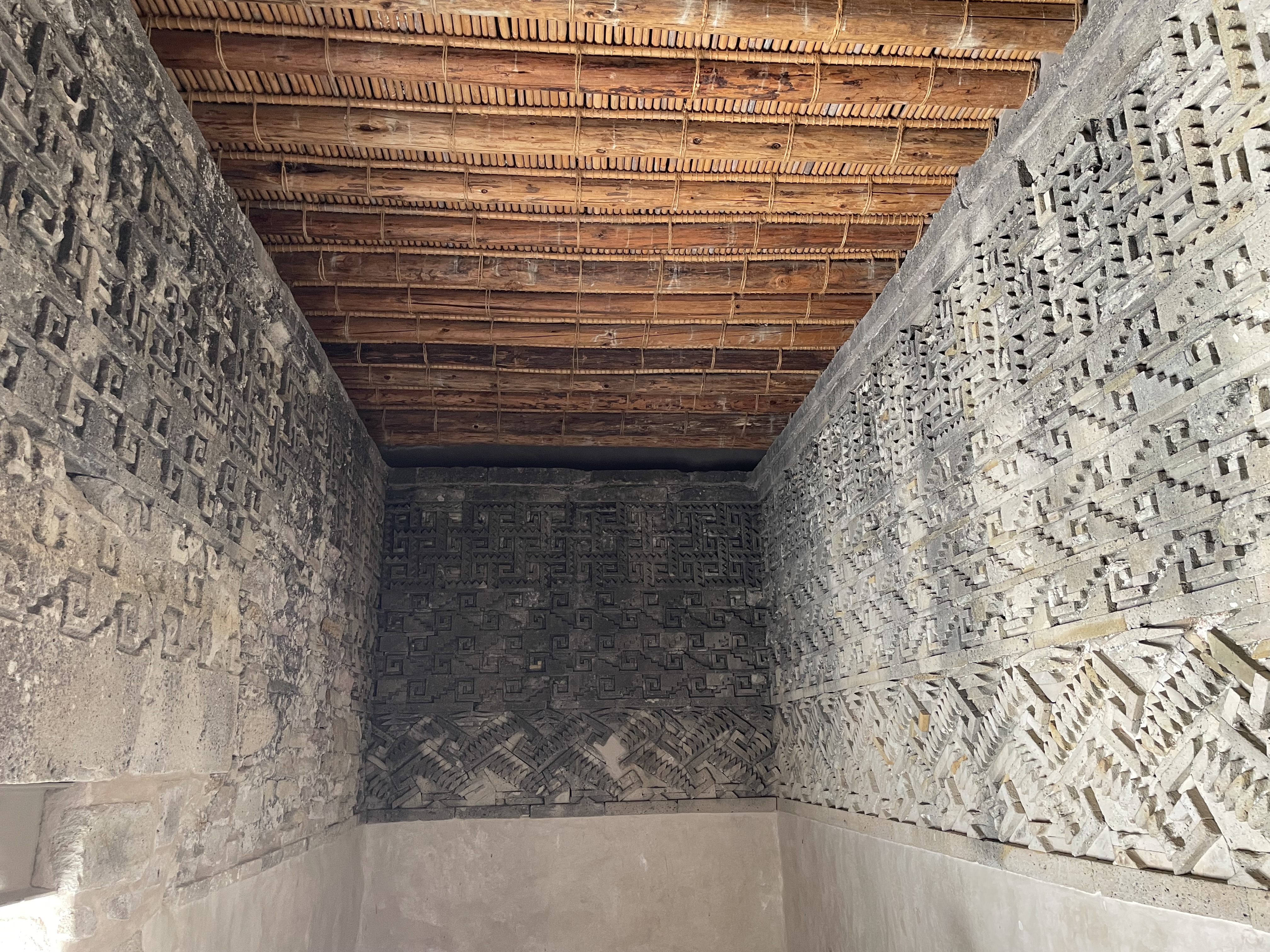
A unique feature of these ruins is the geometric patterns in the walls. Archaeologists agree that these have symbolic religious meaning, but disagree on the precise interpretation of each.


One thing on which they agree is that a major deity worshipped here was a god of earthquakes -- significant in this seismically active area.


Also significant is that these buildings have survived here for more than a thousand years, while the church and other buildings constructed by the Spaniards have had to be rebuilt several times due to earthquake damage.


The geometric patterns are not simply carved into the stone (which would have been difficult enough for a culture without metal tools). Instead, smaller stones were carefully shaped and put together like an enormous jigsaw puzzle to create the patterns.


After our visit to the ruins, we drove a short distance to a restaurant for a really excellent all-you-can-eat buffet lunch, featuring several kinds of mole sauces.


After returning to Oaxaca, we embarked on a walking tour of the mercado (market). As markets in developing countries go, this one was pretty clean, though the aisles were narrow and cramped.


Grasshoppers seem to be a favorite snack food or dietary supplement here, and they were in abundance in the market.


There was a bit of everything in the market (even religious shrines), but among the crafts Oaxaca is known for is leather goods. I bargained for a leather belt and got a pretty good deal. Mary looked briefly for a purse, but didn't find one that tripped her trigger.


The local guide continued our walking tour through the old city center, past the cathedral, and eventually back to Santo Domingo church, which we had walked by last night.


This time, we got to go inside. The baroque decor and extensive use of gold leaf were stunning. However, it was very dark inside, so the photos don't do it justice.


Dinner was to be on our own, but we were too full from lunch to want anything more than a snack.

Wednesday, February 5, 2025

Road Trip

We left Puebla this morning for a long drive across the Sierras to Oaxaca. There isn't much to say about the drive, other than that we got to see an active volcano...


...and a lot of cactus.


We needed to stretch our legs upon arrival, so we walked around the neighborhood. We are very near the old center of the city.


Balam took us on an orientation walk on the way to dinner, and we got at least a glimpse of the old town.


It looks like a marvelous place, and we'll see more in the coming days. Dinner was excellent!