Thursday, June 5, 2025

Brasov

Brasov (pronounced BRAH-shov) is an industrial city in Transylvania, but the old Medieval city center was untouched by the wars of the previous century and is wonderfully restored. Although archaeologists have found evident of human settlement here dating back 9000 years, it was established as a trading center settled by Saxon merchants in the 13th century. 


At that time it bore the name Kronstadt, and was a key center for trade between Vienna and Istanbul. Most of the old Saxon families fled from the communists and went back to Germany. Briefly named "Stalin City" in the 1950s, the Romanian name comes from the nearby Brasov River.

Our day began with a bus ride up the "mountain" (large, steep hill) to a scenic overlook. Because there is so much smog hanging over the city, we could have skipped that. Then the bus brought us back for a walking tour of the old town.


The key landmark in the old city is the "Black Church," which got its name -- possibly -- from a great fire that swept the city in 1689. Or from industrial pollution in the 19th century. In any case, it's no longer black. The church is one of the largest Gothic structures in Eastern Europe, and became a Lutheran congregation as a result of the Reformation in the 1540s.


The reformer who led that transition was a guy named Johann Hanterus, who has a statue outside the church. Our tour leader tried to tell us that old Johann was a personal friend of Martin Luther, but the dates and places are wrong, and when asked by the town council to create a theological statement, he appears to have been unaware of the Augsburg Confession or many of Luther's writings.


The church, however, still functions as a congregation of Evangelical Church of the Augsburg Confession in Romania.


When we visited, the organist was practicing and we got a free concert, despite noisy tourists. There are actually four organs in the church, though it appears that only the largest and newest one (from the 1850s) is actually functioning.


An interesting feature of the church is the collection of oriental rugs hung on the walls. There were Turkish imports that were used as funeral palls for wealthy merchants, then donated to the church as memorials. It's actually one of the largest collections of genuine Turkish rugs in the world.

While the Black Church dominates the old town, it is surrounded by Roman Catholic and Orthodox churches. The Hungarian population is mostly Roman Catholic, which Romanians tend to be Orthodox.

After a bit of a break for lunch, we took a hike along a trail through a wooded park on a hillside above the old city. The path was mostly paved, but in some areas gravel.

The path took us to the "White Tower," a watchtower that was placed outside the old city walls to prevent invaders from sneaking up on the city from above. The tower remains white, except for the graffiti.

Farther along we came to the "Black Tower," which served the same purpose, although it had a different architecture and was built of different materials. Like the Black Church that it overlooks, the Black Tower is no longer black.

Both towers offer a panoramic view of the old town.

We returned on a lower path that runs just outside of the old city wall which is cleverly named, "Strada dupa ziduri" -- which translates as, "The street behind the walls."

All of that hiking on a hot day made us thirsty, so we continued to the old town square and enjoyed a local beer at an outdoor cafe. We had hoped for some good people watching, but it was too hot for many people to be out. We wound up reading books on a bench in a nicely shaded park near our hotel for a while.

We returned to the square later, however, for a bowl of soup for dinner. It was excellent soup, and there were more people to watch in the cool of the evening.


Wednesday, June 4, 2025

Backstreet Bucharest

Tour leaders bravely took dozens of American tourists who have never ridden mass transit for a ride on the Bucharest Metro this morning. This group demonstrated yesterday, when we checked into the hotel, that getting on an elevator was a challenge for them. However, without too much comedy, they managed to get us herded onto the subway for a brief ride to the next stop.


Once we had disembarked, we emerged at the University Plaza. Unfortunately, most of the university buildings are under renovation, and were shrouded in scaffolding. But nearby we saw the National Theater and other nearby buildings.

We then walked a short distance to the National Bank of Romania which, unlike the beautiful building across the street, has been fully restored to its socialist mediocrity.


Walking further into the Old Town district of Bucharest we visited a Medieval caravanserai (an overnight stopover inn for traders and their animals) that is now a fancy restaurant.


We also visited one of the oldest Orthodox churches in Bucharest, where we witnessed a very unusual act of veneration for the relic of a particular saint. The relic sat on a marble table, and beneath the table was a cushion. We watched an elderly woman get down on the cushion and crawl under the table to the other side. She then walked around to the front of the table and repeated the action, for a total of three times.


Nearby, we saw the ruins of one of the many castles that once belonged to King Vlad (a.k.a. "Dracula"). It's in bad shape, but is also being renovated to become a high class restaurant. More's the pity.


Along the way, we came across part of a high school graduation ceremony taking place outdoors in a park. Because of the heat, students were shedding their black gowns. They were dressed to the nines underneath.


Thanks to Google Maps on my phone, we managed a long walk in the hot sun to the old Jewish quarter. There we made a "donation" in order to visit the Great Synagogue of Bucharest, which is now a Holocaust museum. We didn't have time to stay long.

Back at the hotel, we were granted a late checkout in order to prepare for our bus ride to Transylvania. But we were a little too slow to get to the bus, and because others seemed to assume that they were entitled to spread out over two seats, we weren't able to sit together. Mark was in the back with all the coughing and sneezing. There are suddenly a lot of sick people on the trip.


The Carpathian Mountains are not the Alps or the Rockies, but they are quite beautiful and the wealth in the resort villages along the way demonstrates that money does, indeed, flow uphill. Unfortunately, we drove through fog and heavy rain much of the way, so we got few photos.

As we neared Brasov, however, the skies cleared and we were able to see that this city of 300,000+ still shows its communist past, but like Bucharest, has dressed it up with fresh paint.


Our hotel is in the old city center and surrounded by charming old buildings that are well preserved. The entire old town area, which is quite extensive, is a pedestrian-only zone. We walked to dinner, but we are anxious to see more.

Tuesday, June 3, 2025

Romanian Backtrack

The M.S. River Adagio is our home no more. We packed up and left the ship this morning and spent the next several hours on a bus, going back the way we came on the boat. We even crossed the Danube three times on the highway, seeing places we had just been the day before.

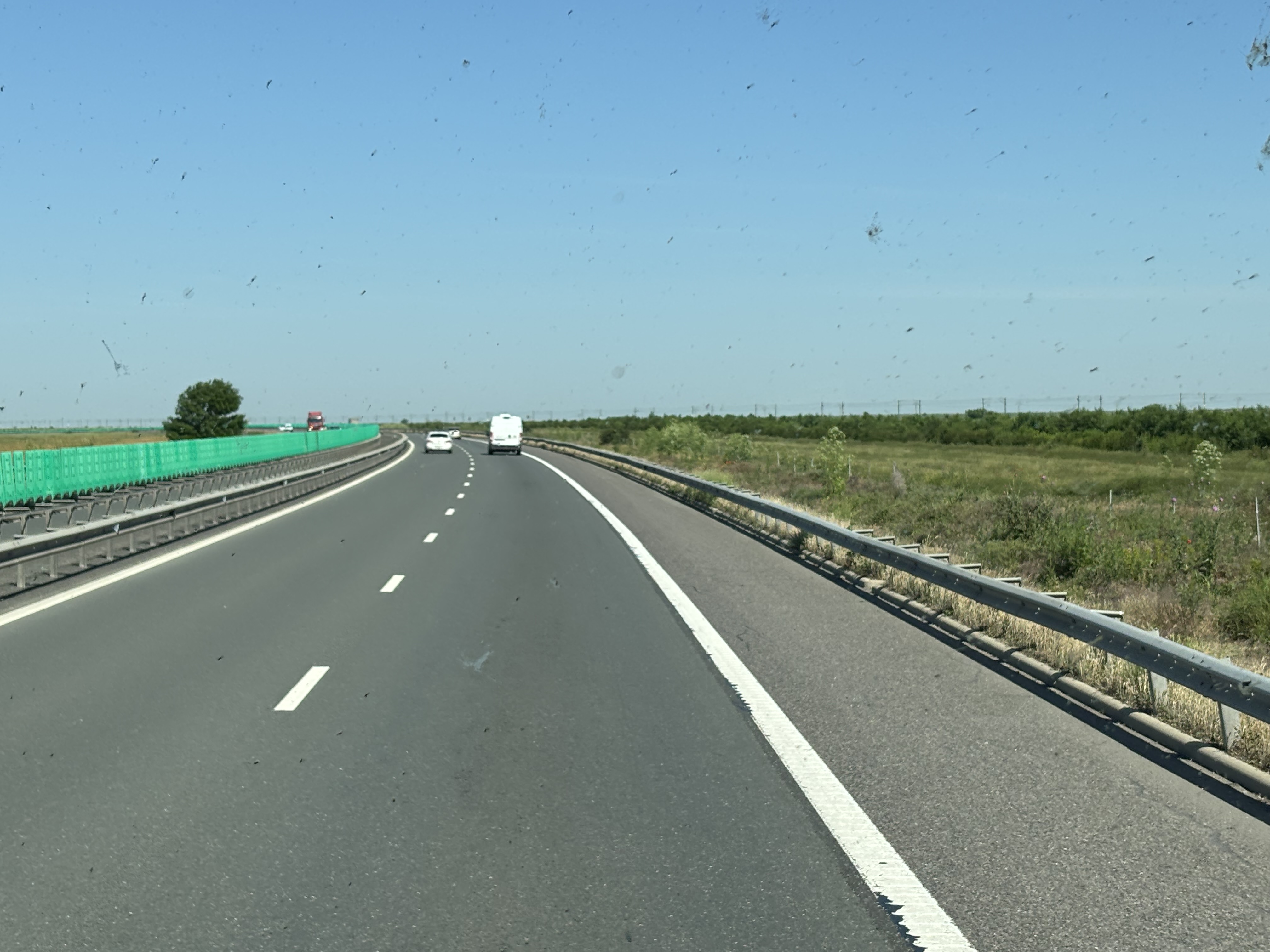
The motorway was in better condition than a lot of Interstate highways in the U.S. It's a toll road, but all tolls are collected electronically so we had no stops for that.


The terrain when we left Constanta was rolling hills. It looked a lot like Iowa or Minnesota. But shortly after our second crossing of the Danube - Black Sea Canal the land became tabletop flat. The fields are huge and there are no farmsteads. Farmers drive equipment from towns.


At a rest stop we encountered a Roma ("gypsy") woman who had parked her horse and wagon among the wild poppies that line the road.

We arrived in Bucharest in time for lunch. Our tour director told us that we were nearly there and to get ready to leave the bus. Then we inched our way through heavy traffic on city streets for another 45 minutes. All three of the other buses with Adagio passengers arrived ahead of us. We wonder if our driver was lost.

Lunch was very good. And as soon as it was finished we met our local guide and got back on the bus for a city tour. Big meal, hot day, warm bus -- the guide wasn't bad, but we couldn't stay awake.


We stopped in Revolution Square, across the street from the Presidential Palace, where we met a Romanian man who participated in the demonstrations that led to the ouster of Romanian dictator Nicolae Ceaușescu in 1989.


We continued on to the Parliamentary Palace -- the second largest building in the world, after the Pentagon in Washington, D.C. 


This huge building -- which Ceaușescu nearly bankrupted the country constructing -- is not sufficient to house the entire government and bureaucracy of little Romania. There are more government office buildings lining the avenue that leads to it.


Bucharest still bears the marks of its communist past, but with a lot more fresh paint, tree-line boulevards, and nicely restored older buildings than cities in some of the other countries we've visited. It was known as "the Paris of the East" in its pre-communist days, and that classy history shines through, too.


After checking into the hotel our tour leader took us for a walking orientation of the neighborhood. On his recommendation we visited a bakery that specializes in French-style eclairs. They were a bit pricey, but very good.


Then we went to a grocery store and bought cheese sandwiches for dinner. Nothing like having dessert first! But the sandwiches were also quite good, and incredibly cheap.

Monday, June 2, 2025

Constanta

Passing from Bulgaria to Romania we passed through the Danube-Black Sea Canal. Begun at the behest of Stalin in the 1940s, the Romanians began the canal using 60,000 or more political prisoners as forced labor. The project was abandoned, then revisited in the 1970s when more mechanized equipment was available.


A large monument commemorates the laborers who died in the project, especially those who succumbed when forced labor conditions were harsh.


Constanta, Romania is the largest seaport on the Black Sea, and we got a grand tour of it today when we left the Danube Canal and navigated through the port to our berth. We are docked just across from the Romanian Navy. We didn't realized their navy was as large as this! The ships included a sailing vessel used for training naval cadets.


We docked late morning and after lunch got on buses for a city tour. The city is a bit more modern than those in Bulgaria, but the evidence of the communist past remains.

The walking portion of the tour was through the old city center, beginning with a folk art museum. This primarily featured textiles, but with a few icons and other artifacts.


The city center is clearly geared to tourism from boats such as ours, with lots of shops and restaurants with signs in English. The fusion between Roman, Byzantine, and Ottoman cultures is evident, especially when there is a mosque next door to a huge Orthodox church.


We weren't able to visit the mosque, but the church was quite beautiful in the ornate, Orthodox style.


Our walking tour continued to the promenade overlooking the Black Sea. It is also the location of a grand casino, but for the entertainment of the populace and for the enrichment of the local government. The communists allowed the building to fall into disrepair, but it has recently been restored and has resumed its original function.


The bus took us to a public beach where we could actually touch the Black Sea. Some group members were more enthusiastic about this than we were, wading out into the water.

In the evening, we were invited to dine at the Captain's Table. Our captain is a very nice man and clearly very respected by his crew, but he speaks very little English. Fortunately, the program directors were seated with us so that the conversation was easier.


It was a huge meal, ending with flaming Baked Alaska on parade. We returned to our room very stuffed.

Sunday, June 1, 2025

Arbanassi

The boat docked early this morning at Ruse (RU-seh) on the Bulgarian side of the Danube. After breakfast, we got on a bus to take us on the optional tour inland to the village of Arbanassi and the city of Veliko Turnovo. It was a beautiful sunny day with a high in the low 80s.


The bus ride was nearly two hours through Bulgarian farmland. In some places the land was fairly flat, and in other places it was rolling hills. It might have been eastern Iowa, except that the fields were huge (possibly a carry over from collective farms in the communist period?) and, more startling, there were no farmsteads.


We didn't see a barn, shed, or farmhouse anywhere. The local guide indicated that farmers live in the villages, park their tractors and other equipment on the edge of town, and go out to their fields from there. But we also saw no equipment working in any fields, so that was hard to verify.


Arbanassi is a village that has escaped the ravages of many wars and is a collection of "fortified houses" dating back other the 17th century. The houses were fortified, with stone walls around them, stone lower floors, barred windows, and other security features because of bandits and marauding gangs. During the Ottoman period there was little in the way of law enforcement.

The interior of the home we visited (now a museum) had many Turkish features, including the "beds" on which people sat in the living and dining areas, and even the indoor squat "toilets" (which were just holes in the floor.


From the home, we went to visit an Orthodox church that also dates from the 17th century. The church was fascinating! 


During Ottoman occupation the building of churches was heavily restricted. No church could be larger than the smallest mosque in the region. No steeples, domes, or bell towers were allowed. Nothing on the exterior could indicate the purpose of the building or display any religious symbols.


The interior was a different matter. Because Muslims were forbidden by their religion to enter a church, the Orthodox Christians could pretty much get by with anything. No Ottoman official would ever see it.

So the entry room to the church was plain whitewash. If anyone standing outside happened to look through the doorway, it would appear to be absolutely without any decoration or symbols. But turning the corner, one entered an ornately and opulently decorated vision of heaven.


Because the church could not be built very tall, the builders dug into the ground so that the ceilings could still be high. Though no dome was permitted on the exterior, a domed ceiling was hidden within a plain, square exterior.

Nearly every inch of the interior was covered with icons, and gold leaf was used extensively. Roman bricks were retrieved from old ruins and repurposed to create the highest quality floors.

Unfortunately, candles and oil lamps were the only source of light. So the icons became caked in soot. But the post-communist Bulgarian government had recently paid for art restorers to clean the walls and reveal the original brightness of the decor.


Four elderly local men came into the church to perform Orthodox liturgical music for us. The acoustics were great. The elderly voices, not so much.

From the church we walked to a local restaurant for an excellent lunch, including some of the best baklava we have ever tasted. Then it was on to the nearby city of Veliko Turnovo. 


This city of about 140,000 was once, in pre-Ottoman times, the capital of Bulgaria. From a distance, we were able to see the fortress castle from which the Bulgarian kings ruled. 


Then we were taken on a tour of the craft shops that cater to tourists and given free time to shop. I'm afraid that we did little to help the local economy, but of course, some of our fellow travelers made up for us.

The local guide yammered continuously with useless trivia throughout the day, but was mercifully silent during most of the trip back to Ruse. The aged and infirm remained on the bus to go back to the boat, but those of us who had energy remaining were dropped off for an hour in the city center of Ruse.

Both Veliko Turnovo and Ruse definitely still display their communist heritage. The old buildings need restoration, and the newer buildings are still the depressing, grey Soviet style piles of concrete that one sees all over the former Soviet block.


However, Ruse was celebrating the Children's Day holiday, and the city center was filled with families, with many kids dressed up in traditional costumes. It was a grand party all through town.

Back on the boat, we were fed and watered in typical style as we left port to sail for Romania and the Black Sea. This cruise will soon be over.