Wednesday, January 26, 2022

The Middle of the World

First stop this morning was Mercado La Carolina — a typical market in Quito, with stalls for various vendors selling fruit, vegetables, meat, fish, etc. As Third World markets go, this was one of the cleanest and most orderly that we have seen.


We encountered most of the typical staples, plus a number of fruits that are unique to this part of South America. The market was well stocked, and everything looked very fresh, but it was not very crowded with shoppers.


There was a large food court, where vendors were preparing and selling prepared meals. It seemed that there were more customers sitting and eating breakfast at 8:30 a.m. than there were people shopping for their groceries.


We then drove just outside of Quito to the suburb of San Antonio de Pichincha where we visited Museo Intiñan — a museum (yet another) about the indigenous people of Ecuador. However, we saw very little about the natives.

Just outside the museum grounds, we passed a large monument, “The Monument to the Equator.” This 100 foot-high stone pyramid was erected about 1979 to commemorate the French-Spanish Geodesic Mission of 1736, which established the position of the equator at this point.

Unfortunately, while the French did a pretty good job using 18th century technology, modern GPS and other measurements have established that they were about 240 meters off. The actual line happens to run through the grounds of the Museo Intiñan. So that’s what we learned about on our visit.

Our museum host took us to a spot where a line had been painted on the concrete. Here we had the obligatory photo, standing in two hemispheres at once.

He then began demonstrating all of the fantastic physical properties of the equator, such as draining water out of a tub with the water going straight down. He then moved the tub about eight feet north and repeated the experiment, watching the water circle the drain counter-clockwise. And finally, the same tub was moved to about eight feet south of the line and refilled, so that we could watch the water circle the drain clockwise.

There were other demonstrations, such as balancing a raw egg on the head of a nail, which we were told could only be done precisely on the equator. He had us all try, and only two in the group succeeded. The physician from Peoria and I both received certificates of achievement.

There were some others, such as having us walk the line like drunks walking for a state trooper, or holding our arms out straight, that were supposed to be much more difficult exactly at that point.

Some of this just doesn’t add up, of course. If it is that easy to demonstrate where the line is, why were the French 240 meters off? And there is all sorts of folklore about balancing eggs only at equinox or on Easter, etc. But it was at least entertaining.


At the end of the visit, we were briefly shown one indigenous dwelling made from forest materials and stocked with 19th century objects, and we saw a llama in a pen on the way out. I’m not entirely sure why it was there.


On the way back to the bus, we were met by a Tourist Police officer with a hand puppet who had the puppet tell us, in a squeaky voice, to be careful to avoid pickpockets and to always wear our Covid masks. It’s easy to be a ventriloquist while wearing a surgical mask — we never saw his lips move, because we never saw his lips. We thought it must be a really lousy assignment for a cop, and the poor guy was probably cursing every minute he had to stand there doing that.


The bus drove us a short distance to Casa de Agave. We got mixed messages on this one, hearing once that it was some sort of project to help women, and another time that it was an ecological group, and yet another message that it was a commercial distillery.

In any case, we learned more than we ever wanted to know about agave plants, how many species there are, how they grow, how they are harvested, their place in native culture, etc. There was even a demonstration of how volcanic rock causes us to feel certain energy, which didn’t quite fit the whole agave motif.


The tour was paused for us to be seated and served a very nice lunch, featuring some foods we’d not yet had. The dessert was especially good.


After lunch, the tour continued to a room with a bunch of stainless steel and a still that looked like something from a 1920s mountain moonshine operation. Here we were told about fermentation and distillation, and a girl in a lab coat (with help from one of our group members, who was also put in a lab coat) demonstrated for us that distilled agave liquor burns if you set a flame to it. She also demonstrated that it makes good hand sanitizer. We all got a squirt.


Finally, we were taken to another room where we had an elaborate tasting of agave products, leading up to the final, “award-winning agave spirit.” We were told several times that this was “agave spirit” and not tequila. However, we drank our little shot with salt on the back of our thumb and a slice of lime to follow up. It tasted a lot like tequila.


The bus dropped us at the Quito Botanical Gardens on the way, as others continued back to the hotel. It was very nice, with some very beautiful tropical orchids and other flowers and plants.


After we had gotten our fill of the gardens, we set out to walk back to the hotel. It was supposed to be a 30 minute walk, but Google Maps apparently doesn’t care if you’ve downloaded an offline map for central Quito. The map refused to load.


We had to ask directions three times. Two of the people we asked told us to take a taxi because it was too far. But even with getting a bit lost and adding several extra blocks, it was not much more of a walk than we do at home on a daily basis.

Ecuadorians must think Americans are too weak to walk.

Anyway, we made it back safely. We had a couple hours to rest before having to go for our Covid tests. Even though we had to be tested to enter Ecuador, another PCR test is required to go to the Galápagos Islands — which are a part of Ecuador.

Ecuador has mandatory vaccination, with something like 85 per cent of the population now fully vaccinated. We had to show our vaccine cards to get into everyplace we went today, even the vegetable market. Masks are mandatory, too. We learned today that, even if you are in your own car, driving by yourself, you can be pulled over and fined $110 for not having your mask on! And U.S. drivers can’t even put their phones down.

It was a nasal swab test that went WAY up and tickled the brain. It was much cheaper than the same test in the U.S., but we were charged up front. Results in 24 hours.

Tuesday, January 25, 2022

Back to Quito

The rain forest got some rain this morning. Shortly after we awoke, there was a deluge outside our cabin. It stopped just in time for us to walk to breakfast, but rained again while we were eating. The rain abated once again as the big, motorized canoe was being loaded. But no sooner had we gotten tucked in under the canopy, it started pouring once again. It rained off and on throughout the journey back to Coca City, sometimes coming down quite hard, but we stayed dry.

A baby boa waited for us outside the lodge before breakfast

The airport at Coca has no jetways, but they were kind enough to hand us each a large umbrella as we left the terminal gate and walked across the tarmac to the plane. At the top of the air stairs, another guy took them from us as we stepped onto the plane. So we still didn’t get wet.

Ceramics at the museum

The bus from the airport took us directly to a small museum of indigenous culture where we were served a delightful lunch, followed by a short tour of the collection. One gallery was devoted to the shamans of the various societies, while another focused on festivals and the associated costumes.


Yet another exhibit featured indigenous musical instruments, including some that have been appropriated from exposure to Spanish culture. There were jungle violins, marimbas, and even a saxophone made from bamboo!

Following our tour, and the obligatory exit through the museum shop (no, we didn’t), the bus transported us a short distance to the hotel. By happenstance or design, we were assigned to the exact same room we had been in before our trip to the Amazon.

The humid Amazon is not a good place to dry clothing — not even quick-dry travel clothing. So our first order of business was washing the sweat out of a number of shirts and pants. Once those were hung to dry, we went for a walk to explore the neighborhood around the hotel.

The neighborhood around the hotel features many grand old homes. Most have now been turned into businesses.

We visited a very nice shop, but found it rather pricey. Another was selling only Chinese junk. So we gave up the search for Christmas ornaments for the time being. A visit to a local bakery was much more successful. After two big meals already today, a sweet snack was just the ticket.

Interestingly, whether due to Covid or the possibility of crime (we’re not sure which), we found that many stores keep their doors locked, with either a doorbell button or a sign instructing patrons to knock. One shopkeep simply looked through the glass and promptly let us in. Another wanted to see our vaccination cards and spray our hands with sanitizer before we entered.

Also, take note, U.S.A — there is a nationwide mask mandate here. It applies even if one is out walking on the sidewalks of the city. There is a $100 (U.S.) fine if you are caught with your mask off in public, except for eating and drinking. Ecuador takes this seriously. We saw a few unmasked people on the streets of Coca City, but here in Quito, even the street beggars and homeless are masked all the time. One hardly ever sees an exception.

Our walk took us past the neighborhood church.
Roman Catholic, of course.

Our walk brought us to a very nice park, so we walked through some of it. There were nice paved paths, separated for walkers/runners, with other paths marked for bicycles. There were quite a few of both, walkers and bikers, of all ages. The playground equipment was modern, well-maintained, and looked like fun.

We returned to the hotel for a bit of siesta and to catch up on the internet, as we had limited access in the Amazon. We capped the evening in the hotel bar, using the “free welcome drink” ticket we had received at 3 a.m. on the night of our arrival.


Monday, January 24, 2022

Family Time

Overseas Adventure Travel always tries to include a “day in the life” experience in every one of their tours. Often, this includes a visit to a school, clinic, or social agency, in addition to a home-hosted meal. Covid has made school and clinic visits unwise, to say the least. So our “day in the life” was an extended home visit to a family living in a small settlement on the opposite side of the Rio Napo.

We traveled by large, motorized canoe. Because of the strong current and large sand bars (the Napo is miles wide but inches deep), the boat had to take us on a somewhat round about route.


Immediately upon landing, we encountered a low-hanging termite nest, and our tour director, Juan, used the opportunity to talk about these insects and their place in the ecology.


We were met almost immediately by our hostess, Niela. She is a Showna woman married to a Kichwa man. They have four children and live primarily by farming. However, pre-Covid, Bruno, the husband, worked as a boat driver for one of the oil-drilling rigs.


Niela showed us her garden, where she was raising yuca, plantains, and a variety of herbs. She demonstrated how she harvests the yuca and immediately re-plants part of the stems, which will grow into new plants in about three months.


She also demonstrated how palm fronds are used to make thatched roofs for local houses. The technique was the same as was demonstrated to us on our jungle hike yesterday, but these roofs last only 5 to 10 years. People use whatever type of palm is available, and the best choices aren’t easy to find everywhere.

After getting the chance to smell or taste a variety of herbs, we finally made our way to the house. Actually, the family lives in two adjacent structures. One is a small, enclosed building with a raised floor and tin roof that is one open room used only for sleeping. The other is an open-sided, bamboo and palm-thatched shelter with hard-packed dirt floor, used for cooking and eating and most other family activities.

One of the kids wanted to show off his pet turtle

This seems primitive, and would be by U.S. standards, but they have electricity, internet, and the out-house has running water with flush toilet and a nice-looking tiled shower. Another building is a chicken coup.

The grandfather in traditional dress

We were introduced to the children, as well as to Bruno’s father, who is a tribal elder and a shaman healer. We also met Bruno’s sister and nephew, but it wasn’t clear if these last two lived here or just nearby. In any case, the family consists of three generations.

Niela demonstrated the process of making chicha, the native fermented drink made by mashing cassava root and sweet potato.


Then we went to work on the main course, which was river fish prepared with salt and wrapped in a palm leaf, sort of like a tamale.


In addition, we were to have the “delicacy” of the huge beetle larve — just like those we had seen in the market at Coca City. I had the honor of completing one skewer of five fat worms. The process involves fishing a wiggling live one out of the bowl of water, using fingers and thumb to crush its head to kill it (harder than it looks), then stabbing it with the skewer at the head and through to the tail end. 

Then you slide the slimey critter down the skewer to make room for the next one. The skewer is then placed over the fire until the larve are crisp. (They have sort of a bacon flavor, but were not my favorite.) All of the food was served in a gourd, and there was no silverware — all finger food!

The meal ended with the serving a guayusa, a tea made from local plants, and the traditional cup of chicha. The tea was good, the chicha — meh.


After the meal we had a question & answer period with Juan translating. The family members had a couple questions for us, and we had a bunch for them. That concluded, we were ushered outside, where Bruno wanted us all to try hitting a target (constructed to look like a bird) with his blow gun and his spear. Only one guy in the group hit the target with the dart. Not even Bruno hit with the spear.


Before departing, the children wanted to give us the gift of Toucan noses made from Bird of Paradise flower blossoms. Mary gave them some stickers in return. We finally took our leave, feeling that it was one of the better “day in the life” experiences that we had had on OAT trips.


After a bit of siesta, we gathered in the main lodge for a lesson in making chocolate from cocoa beans. Of course, the entire process takes days, but we opened a pod. Then we had the opportunity to shell some roasted seeds, and to grind them into powder. The best part was sampling finished candy bars that Juan had obtained previously.


That activity concluded with a long discussion of Juan’s life growing up in the Amazon, his family, customs, what happens when there are illnesses and deaths, how marriages are arranged, etc., etc. It was very interesting, and went much longer than planned, right up until dinner. The group is becoming better acquainted, so the dinner conversation is more lively and continues long after the meal.

Sunday, January 23, 2022

Yarina Lodge

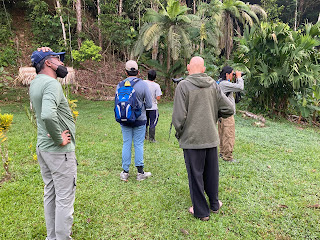
We were awake before the sun and got ready quickly to join our tour director, Juan, for a 6:15 a.m. bird watching session. The morning was cool and beautiful, but the humidity was already off the scale. Others in our group were eagerly recording their sightings in their bird watching apps, and Juan was amazing in his ability to spot birds at great distance and. Identify them precisely, even before getting his binoculars up to his eyes.


We were more on the scale of “small yellow bird,” “big black bird,” “woodpecker.” But we were pretty soon able to tell the Yellow-tailed Weavers from the Jays. We also got a look at a few monkeys that were starting the day early in the trees, as well as a few butterflies.

Breakfast was an egg, empanadas, and local fruits. Then we had a few minutes to gear up for the morning walk. We went quite a bit deeper into the jungle this time, and even though we were on an established path, Juan’s younger brother, who happens to work at this lodge, had to use a machete in several spots to clear the way for us.

Juvenile Rainbow Boa Constrictor

The emphasis for this walk was on how the indigenous people use what the jungle provides in order to survive. Since Juan and his brother are indigenous and grew up in the area, they were well-versed in the topic.

We saw how a certain type of tree sap was used as an antibiotic, while the sap of another tree nearby could be processed into a paste for patching canoes or making other repairs (jungle duct tape!).

We had a lesson on how to make a single-use basket of palm leaves on the fly, in case one came across some ripe fruit while hunting and gathering. Another lesson showed how a different palm leaf is utilized to create a thatched roof that lasts 20 years.

In a lesson on how to make string, we saw Juan create one that none of us could break, and that could be used to weave a hammock or make a bow. Our efforts to duplicate the process were less successful.

We also got a demonstration on how to create a poison dart for use with a blow gun — this is a real deal and not just Hollywood. The darts are incredibly sharp, masterfully straight, and can be blow accurately up to 50 yards! We were even introduced to one of the frogs used to make the poison, but the process of getting the poison from the frog to the dart is too involved to be shown in a few minutes.

The heat of the day grew more intense, and we had a minor medical emergency when one of our group became dizzy and feared he would pass out. Fortunately, another couple on this trip are semi-retired family practice physicians, so we didn’t have to resort to tree sap or any other sort of jungle remedy.


We eventually reached the creek, where three canoes were waiting for us. These were closer to regular sized canoes, not the motorized model that we arrived in from Coca City.


Lunch was, once again, delicious, but similar to the other meals in many ways. Broccoli soups was served with popcorn, as all soups are here. The main course was meat and rice with a sauce or gravy made from beans. The mango mousse dessert was wonderful.

After a bit of a siesta, we met in full jungle gear once again at 3:30 p.m. to get back into the big, motorized canoe and head back into the jungle. We docked along the creek and walked a short distance to a lagoon between the creek and the river. Here we spotted several more species of birds. Again, our level of sophistication was along the line of “big, white bird,” and “bird with orange breast.” But the birders were eagerly jotting down genus and species from our tour director's encyclopedic knowledge.


We all got a plain wood pole and string to fish for piranha. Mary caught one, but it got away before she could land it. Others in the group caught three more tiny ones, two different species, which we examined before throwing them back,

In early evening, just about sunset, we returned to the same place. The canoe briefly went out onto the river, which gave us a wonderful view of the sunset. Back at the lagoon, we go aboard smaller canoes, three tourists and one paddler per boat, and set out on the water.

What a treat the nighttime experience was! We saw many bats, an amazing display of fireflies, huge frogs, and even the eyes of a caiman, watching us from a distance, as its eyes reflected our flashlights. But the most significant part of the experience was the sound. So many creatures announcing their presence made for a symphony of percussion.

We returned for a good meal and a nice shower before bed.

Saturday, January 22, 2022

Coca City

Our wake-up call came early, but we were awake even earlier. Just excitement, I guess. Showered and dressed, we put our bags out for the bellmen and went to breakfast. Saturday breakfast wasn’t as varied as what was available the day before, but we had plenty to eat.

We boarded a bus for the 45 minute drive to the airport. This was a more sedate trip — our 2 a.m. cab driver had considered speed limits and red lights as merely advisory. This driver had a bit of traffic to contend with. We noticed a number of things in daylight that we had missed at night.

Also missed, in our sleep-deprived stress when no one was waiting for us at the airport, was just how nice Quito’s airport is. It’s new, beautifully designed, efficient and environmentally friendly.


Our flight to Coca was not full by any means. Nor was it lengthy. In 30 minutes we were back on the ground. But the difference in airports was stark. Coca’s runway runs parallel to its Main Street, and there are probably not 100 yards between them. The back of Main Street businesses and residences are literally adjacent to the airport fence. This terminal made the Waterloo, Iowa terminal look like an enormous palace.


It was indicative of Coca, a city of about 45,000 that is, to put it kindly, a dump. It was reminiscent of China in architecture and cleanliness. It’s an industrial city, mostly supporting the oil drilling industry in the Amazon Basin. An Ecuadorian army base is just across the river.

We walked around briefly. In a small market, indigenous people were selling live fish, freshly dead chickens, and all sorts of produce and “medicines” gathered from the jungle. Our tour director purchased a few things for us to taste. We passed on the giant larvae.


After a rather long time waiting for, we know not what, we were issued life vests and placed aboard a motorized canoe for our next 45 minute ride down the Rio Napo, one of the larger tributaries to the Amazon. 

There were only a few signs of habitation along the way — just a few primitive huts and people fishing from much smaller canoes. We were surprised to see so little wildlife, only a few birds.


We turned up a narrow creek, barely wide enough for our boat, and made our way very slowly into the jungle to Yarina Lodge. We disembarked and climbed a long set of stairs up to the main hall. 


Lunch was interesting, consisting of local area foods, plus meat and rice. After an orientation briefing, we had time to settle into our cabins. Ours is quite large and obviously intended to be a family cabin with extra beds for kids. We will sleep under the biggest mosquito net we’ve ever seen!

We met in late afternoon for a short, but very hot and sticky nature walk in the jungle. They insist that we wear long sleeves, long pants, and we are issued our own pair of (somewhat ill-fitting) rubber boots. Water bottles and hiking sticks were recommended. Quite the outfits! 


We saw a few bird species and some monkeys, and also learned a bit about the ecology of the plants, trees, and soil.


Dinner was a different menu, but once again a lot of local foods. On kind of the spur of the moment, our tour leader offered the opportunity for a nighttime jungle walk for any who might be interested. We would have to suit up again, but all but one group member came for the experience.

The walk was essentially the same route that we had taken in the afternoon, but the experience was much, much different. The jungle is alive at night! We saw some very large spiders and equally large insects that were their prey. We encountered several species of tree frogs, including a pair of large ones, mating. Frog sex is always entertaining. 

We got a glimpse of a small caiman (sort of like an alligator), and watched a 6 or 7 foot long anaconda trying to slither up a tree to get to a bird nest. Our tour leader was quite excited about the anaconda, as it is somewhat rare to see one around here.

At one point, our tour leader asked us all to turn off our flashlights and to simply stand and remain silent. The darkness was total. Even looking straight up, only a couple of stars could be seen in the few gaps in the forest canopy. But the jungle was filled with sounds -- frogs, monkeys, birds, insects, a cacophony.

The nighttime walk was definitely worth getting the gear on, and was the highlight of the day. More nature beginning with the sun in the morning.